

The Enduring Value of Engraved Signs and Bronze Plaques
In an era of digital displays, LED signage, and rapidly changing marketing trends, engraved signs and bronze plaques remain a timeless, enduring form of signage that conveys permanence, professionalism, prestige, and respect. From the bronze dedication plaque at the entrance of a corporate headquarters to the engraved nameplate on an executive’s office door, from the memorial plaque honoring a community leader to the room identification signs in a hospital or university, engraved signs and plaques communicate a sense of stability, quality, and significance that no digital or temporary sign can match. They are the signage of record—marking important moments, honoring individuals, identifying spaces, and establishing a lasting connection between a place and its history.
Engraved signs and plaques are particularly valued in professional, institutional, and public environments—corporate offices, law firms, financial institutions, government buildings, hospitals, universities, museums, libraries, places of worship, and historic properties—where a professional, dignified, and permanent appearance is essential. They are also commonly used for memorials, dedications, awards, and recognition, where the permanence and quality of an engraved plaque symbolize the significance of the person or event being honored. Unlike printed or vinyl signs that fade, peel, or become outdated, a well-crafted engraved bronze or metal plaque can last for decades—even centuries—with minimal maintenance, becoming a valued part of a building’s history and identity.
This guide provides a comprehensive overview of engraved signs and bronze plaques, covering the different engraving methods and materials available, common applications and use cases, design best practices, installation methods, maintenance requirements, and how to source high-quality custom engraved signage for your office, building, or institution. Whether you are commissioning a dedication plaque for a new building, ordering engraved office signs for a corporate headquarters, or sourcing memorial plaques for a public space, this guide will help you understand the options and make informed decisions that result in a beautiful, durable, and meaningful finished product.
Engraving Methods: How Engraved Signs and Plaques Are Made
Engraving is the process of cutting or etching a design, text, or image into the surface of a material, creating a permanent, recessed (or sometimes raised) mark that can be read by touch as well as sight. Several engraving methods are used in modern sign manufacturing, each with different advantages, limitations, and suitable applications. Understanding the different engraving methods helps you choose the right technique for your specific project, material, and budget.
1. Laser Engraving
Laser engraving uses a focused, high-powered laser beam to vaporize or remove material from the surface of the sign or plaque, creating a precise, permanent mark. Laser engraving is the most common and versatile modern engraving method, capable of producing highly detailed text, logos, images, and even photographs with exceptional precision and consistency. Laser engraving is suitable for a wide range of materials, including wood, acrylic, plastic, leather, glass, coated metals (anodized aluminum, powder-coated aluminum), and some uncoated metals (stainless steel, with the use of a marking compound).
Advantages of laser engraving:
- Exceptional precision and detail (capable of producing very small text, fine lines, and detailed images/photographs)
- High consistency and repeatability (ideal for large orders or multiple identical plaques)
- Fast production time (compared to traditional hand engraving or chemical etching)
- Wide range of compatible materials (wood, acrylic, plastic, leather, glass, coated metals)
- No contact with the material (reduces risk of material distortion or damage)
- Lower cost than traditional hand engraving or chemical etching for most applications
- Can produce both engraved (recessed) marks and surface marks (color change on coated metals)
Limitations of laser engraving:
- Limited depth of engraving (typically 0.005″–0.020″ deep, depending on material and laser power), which may be insufficient for applications requiring deep, tactile engraving (e.g., ADA tactile signs, heavy-use outdoor plaques)
- Not suitable for engraving uncoated metals (bronze, brass, raw aluminum) without the use of a marking compound (which creates a surface mark rather than a deep engraving); for deep engraving in uncoated metals, rotary engraving or chemical etching is required
- May produce a slightly different appearance on different materials (e.g., laser engraving on wood produces a dark, burnt mark; on acrylic produces a frosted white mark; on coated aluminum exposes the underlying metal color)
- Some materials (e.g., PVC, polycarbonate) may release toxic fumes when laser engraved, requiring proper ventilation and filtration
2. Rotary Engraving (Mechanical Engraving)
Rotary engraving (also called mechanical engraving or CNC engraving) uses a rotating cutting tool (end mill or engraving bit) mounted on a computer-controlled (CNC) machine to physically cut into the surface of the material, creating a recessed groove or mark. Rotary engraving is capable of producing deep, precise engraving in a wide range of materials, including metals (aluminum, brass, bronze, stainless steel), plastics (acrylic, PVC, ABS), wood, and glass. It is the preferred method for applications requiring deep, tactile engraving (e.g., ADA tactile signs, heavy-use outdoor plaques, nameplates with paint-filled engraving) or for engraving uncoated metals (bronze, brass, raw aluminum) where laser engraving is not effective.
Advantages of rotary engraving:
- Capable of deep engraving (0.010″–0.125″ or deeper, depending on material and tool), making it suitable for tactile applications, paint-filled engraving, and heavy-use outdoor plaques
- Suitable for engraving uncoated metals (bronze, brass, aluminum, stainless steel), producing a clean, precise cut that can be paint-filled for contrast
- Produces consistent, repeatable results with CNC control (ideal for large orders or multiple identical plaques)
- Can produce both engraved (recessed) marks and cut-through shapes (for stencils, cut-out letters, or decorative shapes)
- Wide range of compatible materials (metals, plastics, wood, glass, composites)
- Engraving can be paint-filled (with enamel or epoxy paint) for high contrast and readability, particularly on metal plaques
Limitations of rotary engraving:
- Less detail and precision than laser engraving for very fine text, small graphics, or photographic images (the rotating cutting tool has a minimum diameter, typically 0.005″–0.020″, limiting the minimum detail size)
- Slower production time than laser engraving for detailed designs (the cutting tool must physically remove material, which takes longer than laser vaporization)
- Contact with the material (may cause material distortion or clamping marks on thin or delicate materials, requiring proper fixturing)
- Higher cost than laser engraving for many applications (due to slower production time and tool wear)
- Tool wear and breakage (engraving bits wear over time, particularly when engraving hard metals, and may need frequent replacement, adding to cost and production time)
3. Chemical Etching (Acid Etching)
Chemical etching (also called acid etching or photochemical etching) uses a photoresist mask and chemical etchant (acid) to selectively dissolve or etch the surface of a metal plate, creating a precise, recessed design. Chemical etching is a traditional, high-quality engraving method commonly used for bronze, brass, stainless steel, and copper plaques, particularly for high-end, detailed, or large-format applications where deep, precise engraving is required. The process involves applying a light-sensitive photoresist to the metal plate, exposing the photoresist through a photographic negative of the design, developing the photoresist to expose the metal in the design areas, and then immersing the plate in an acid bath (ferric chloride for copper/brass/bronze, nitric acid for stainless steel/aluminum) that etches the exposed metal, creating a recessed design. After etching, the photoresist is removed, and the engraved areas are typically paint-filled for contrast.
Advantages of chemical etching:
- Capable of deep, precise engraving in uncoated metals (bronze, brass, stainless steel, copper, aluminum), with clean, sharp edges and consistent depth
- Exceptional detail and precision (capable of producing very fine text, detailed logos, and intricate designs that may be difficult to achieve with rotary engraving)
- No contact with the material (no tool wear, clamping marks, or material distortion, making it suitable for thin or delicate metal plates)
- Consistent, repeatable results (ideal for large orders or multiple identical plaques, with photographic accuracy)
- Produces a high-quality, premium appearance that is associated with traditional, high-end plaque making (commonly used for dedication plaques, memorials, awards, and institutional signage)
- Can produce very large plaques (up to 4’×8′ or larger) that may be difficult or expensive to produce with rotary engraving
Limitations of chemical etching:
- Higher cost than laser or rotary engraving for many applications (due to the multi-step process, photoresist materials, acid handling, and longer production time)
- Longer production time (typically 5–10 business days, compared to 1–3 days for laser/rotary engraving), due to the multi-step process and acid etching time
- Limited to metal materials (bronze, brass, stainless steel, copper, aluminum)—not suitable for wood, acrylic, plastic, or other non-metal materials
- Environmental and safety considerations (acid etchants are hazardous materials that require proper handling, storage, ventilation, and disposal, which may be restricted in some areas; not all sign manufacturers offer chemical etching due to these requirements)
- Less flexibility for design changes or customizations (once the photographic negative is created and the plate is etched, design changes require starting over with a new plate, unlike laser/rotary engraving where changes can be made quickly)
4. Sandblasting (Abrasive Blasting)
Sandblasting (also called abrasive blasting or bead blasting) uses a high-pressure stream of abrasive material (sand, aluminum oxide, glass beads, or walnut shells) to etch the surface of a material, creating a recessed, textured design. Sandblasting is commonly used for engraving stone (granite, marble, limestone), glass, and some metals, particularly for large-format applications, memorials, and architectural signage. The process involves applying a rubber or vinyl mask to the material (with the design cut out), then blasting the exposed areas with abrasive material to create a recessed, textured mark. After blasting, the mask is removed, and the engraved areas may be paint-filled or left natural for contrast.
Advantages of sandblasting:
- Capable of deep engraving in hard materials (stone, glass, metal) that may be difficult to engrave with other methods
- Produces a textured, matte finish in the engraved areas that provides natural contrast with the polished or smooth surrounding surface (no paint filling required for many stone or glass applications)
- Suitable for very large plaques and signs (up to 4’×8′ or larger), commonly used for building dedications, memorials, and architectural signage
- Can produce both engraved (recessed) marks and surface texturing (for decorative effects or background texturing)
- Relatively fast for large-format designs (the abrasive stream covers a larger area than a laser or rotary tool, reducing production time for large plaques)
Limitations of sandblasting:
- Less detail and precision than laser, rotary, or chemical etching (the abrasive stream has a minimum size and may undercut the mask, limiting the minimum detail size; not suitable for very fine text or intricate designs)
- Limited to hard, durable materials (stone, glass, metal)—not suitable for wood, acrylic, plastic, or other soft materials that would be damaged by the abrasive stream
- Environmental and safety considerations (abrasive blasting produces dust and noise that require proper ventilation, dust collection, and personal protective equipment; may be restricted in some areas)
- Masking material cost and time (applying and cutting the rubber/vinyl mask is a labor-intensive process, particularly for detailed designs, adding to cost and production time)
- May produce a rougher, less refined appearance than chemical etching or rotary engraving, which may not be suitable for all professional or high-end applications
5. Hand Engraving
Hand engraving is the traditional, artisanal method of engraving, where a skilled craftsman uses hand-held engraving tools (gravers, burins, chisels) to cut designs into the surface of a material, typically metal (bronze, brass, silver, gold) or wood. Hand engraving is the oldest and most prestigious engraving method, capable of producing unique, intricate, and artistic designs that cannot be replicated by machine. However, it is also the most expensive and time-consuming method, and it is increasingly rare due to the scarcity of skilled hand engravers. Hand engraving is typically reserved for high-end, one-of-a-kind applications, such as awards, trophies, jewelry, fine art, and commemorative plaques where uniqueness and artistry are valued over cost and production time.
Advantages of hand engraving:
- Unique, artistic, one-of-a-kind designs that cannot be replicated by machine (each hand-engraved piece is unique, with subtle variations that reflect the craftsman’s skill and artistry)
- Exceptional detail and precision (a skilled hand engraver can produce extremely fine lines, intricate designs, and subtle shading effects that may be difficult to achieve with machine engraving)
- Premium, high-end appearance associated with traditional craftsmanship and luxury (hand-engraved items are highly valued for their artistry, rarity, and quality)
- Suitable for a wide range of materials (metals, wood, glass, stone, leather), with the appropriate tools and techniques
Limitations of hand engraving:
- Highest cost among engraving methods (due to the skilled labor required, with hand engravers charging $100–$500+ per hour, and a single plaque taking hours or days to complete)
- Longest production time (days to weeks for a single plaque, compared to hours or days for machine engraving)
- Scarcity of skilled hand engravers (the craft is declining, with few skilled practitioners, making it difficult to find a qualified hand engraver in many areas)
- Less consistency and repeatability (each hand-engraved piece is unique, which may be a disadvantage for applications requiring multiple identical plaques or consistent branding)
- Not practical for large orders or large-format plaques (hand engraving is limited to small-to-medium sizes and small quantities due to the time and cost involved)
Materials for Engraved Signs and Plaques
The choice of material for an engraved sign or plaque significantly impacts its appearance, durability, maintenance requirements, and cost. Different materials are suitable for different applications, environments, and aesthetic preferences, and our guide to sign materials compares every option in detail. The following are the most common materials used for engraved signs and plaques, along with their advantages, limitations, and typical applications

1. Bronze
Bronze is the classic, premium material for engraved plaques, associated with permanence, prestige, and tradition. Bronze plaques are commonly used for building dedications, memorials, historical markers, awards, and institutional signage, where a dignified, long-lasting, and high-end appearance is desired. Bronze is a copper-tin alloy (typically 90% copper, 10% tin) that develops a rich, warm patina over time, changing from a bright, polished bronze to a deep, dark brown or green patina (verdigris) as it oxidizes. Bronze plaques are typically engraved using chemical etching or rotary engraving, with the engraved areas paint-filled (typically black, white, or gold) for contrast.
Advantages of bronze:
- Exceptional durability and longevity (bronze plaques can last for decades or even centuries with minimal maintenance, making them ideal for permanent dedications, memorials, and historical markers)
- Premium, dignified, traditional appearance associated with quality, permanence, and respect (bronze is the material of choice for government buildings, universities, museums, and historic properties)
- Develops a rich, attractive patina over time that enhances its appearance and character (unlike many materials that degrade or fade, bronze improves with age)
- Corrosion-resistant and weatherproof (suitable for both indoor and outdoor applications, including harsh environments, coastal areas, and high-traffic public spaces)
- Can be polished to a bright, shiny finish or left to develop a natural patina, depending on the desired appearance
- Engraving can be paint-filled with a wide range of colors (black, white, gold, silver, custom colors) for high contrast and readability
Limitations of bronze:
- Highest cost among common plaque materials (bronze is significantly more expensive than aluminum, acrylic, or wood, due to the material cost and the more complex engraving/fabrication process)
- Heavier than aluminum or acrylic (requiring more substantial mounting hardware and structural support, particularly for large plaques)
- Requires periodic maintenance to preserve a polished finish (if a bright, polished appearance is desired, bronze must be cleaned and polished periodically to prevent oxidation; if a natural patina is desired, minimal maintenance is required)
- Longer production time (bronze plaques are typically chemically etched or rotary engraved, which takes longer than laser engraving on less expensive materials)
- May be targeted by thieves in some areas (bronze has scrap value, and unattended bronze plaques may be stolen for scrap; security mounting hardware may be required for public installations)
2. Brass
Brass is a copper-zinc alloy (typically 70% copper, 30% zinc) with a bright, golden-yellow appearance that is similar to gold. Brass plaques are commonly used for office signs, nameplates, door signs, awards, and decorative applications, where a warm, golden, and professional appearance is desired. Brass is softer and more malleable than bronze, making it easier to engrave and fabricate, but it is also less durable and more prone to tarnishing (developing a dark, dull patina over time, particularly when exposed to air and moisture). Brass plaques are typically engraved using rotary engraving, chemical etching, or laser engraving (with a marking compound), with the engraved areas paint-filled for contrast.
Advantages of brass:
- Bright, golden, warm appearance that is similar to gold, creating a professional, elegant, and prestigious look
- Softer and easier to engrave than bronze or stainless steel, allowing for detailed, precise engraving with less tool wear
- Lower cost than bronze (brass is less expensive than bronze, making it a more affordable alternative for applications desiring a golden, metal appearance)
- Can be polished to a bright, shiny finish or treated with a patina/antiquing solution for a vintage, aged appearance
- Suitable for indoor applications and protected outdoor applications (with a clear protective coating to prevent tarnishing)
- Engraving can be paint-filled with a wide range of colors for contrast and readability
Limitations of brass:
- Less durable than bronze or stainless steel (brass is softer and more prone to scratching, denting, and wear, making it less suitable for high-traffic or harsh outdoor applications)
- Prone to tarnishing (brass oxidizes over time, developing a dark, dull patina that requires regular cleaning and polishing to maintain a bright, shiny appearance; a clear lacquer or protective coating can slow tarnishing but will eventually wear off)
- Not suitable for unprotected outdoor applications (brass will tarnish and corrode when exposed to rain, snow, and pollution, requiring more maintenance than bronze or stainless steel; for outdoor use, brass should be coated with a clear protective finish and maintained regularly)
- May be targeted by thieves in some areas (brass has scrap value, similar to bronze)
3. Aluminum
Aluminum is the most common and versatile material for modern engraved signs and plaques, offering a lightweight, durable, corrosion-resistant, and cost-effective option for a wide range of applications. Aluminum plaques are commonly used for office signs, door signs, nameplates, room identification signs, directional signs, equipment labels, and outdoor signage, where a clean, modern, and durable appearance is desired. Aluminum is available in several finishes, including brushed (satin), polished, anodized (in a wide range of colors), and powder-coated (in any color), allowing for significant customization. Aluminum plaques are typically engraved using laser engraving (on anodized or powder-coated aluminum, where the laser removes the coating to expose the underlying aluminum), rotary engraving, or chemical etching.
Advantages of aluminum:
- Lightweight (aluminum is about one-third the weight of steel or bronze, making it easy to handle, install, and mount, particularly for large signs)
- Durable and corrosion-resistant (aluminum naturally forms a protective oxide layer that prevents rust and corrosion, making it suitable for both indoor and outdoor applications, including coastal areas and harsh environments)
- Cost-effective (aluminum is significantly less expensive than bronze, brass, or stainless steel, making it the most affordable metal option for engraved signs and plaques)
- Wide range of finishes and colors (anodized aluminum is available in a wide range of colors (black, silver, gold, bronze, red, blue, green, etc.), and powder-coated aluminum can be matched to any color, allowing for significant customization and brand consistency)
- Easy to engrave and fabricate (aluminum is soft and easy to cut, engrave, and shape, allowing for fast production and detailed designs; laser engraving on anodized aluminum produces a sharp, high-contrast mark with minimal effort)
- Low maintenance (aluminum requires minimal maintenance—periodic cleaning with a mild detergent is sufficient to maintain its appearance; anodized or powder-coated finishes are highly resistant to fading, scratching, and corrosion)
- 100% recyclable (aluminum is one of the most recyclable materials, making it a sustainable choice for environmentally conscious businesses)
Limitations of aluminum:
- Less premium or prestigious appearance than bronze or brass (aluminum has a more modern, utilitarian appearance that may not be suitable for applications requiring a traditional, dignified, or high-end look, such as building dedications or memorials)
- Softer than stainless steel or bronze (aluminum is more prone to scratching and denting than harder metals, making it less suitable for high-traffic or abusive environments where the sign may be bumped or scratched)
- Laser engraving is limited to coated aluminum (laser engraving on raw, uncoated aluminum is not effective without a marking compound; anodized or powder-coated aluminum is required for laser engraving, which adds to the material cost compared to raw aluminum)
- May not develop an attractive patina (unlike bronze or brass, aluminum does not develop a rich patina over time; if the finish is damaged or worn, the underlying raw aluminum may be visible, requiring refinishing or replacement)
4. Stainless Steel
Stainless steel is a premium, high-durability metal with a sleek, modern, and corrosion-resistant appearance, commonly used for engraved signs and plaques in corporate offices, healthcare facilities, laboratories, industrial settings, and coastal or harsh environments where maximum durability and corrosion resistance are required. Custom polished stainless steel logos use the same mirror-finish material to create a cohesive brand statement in lobbies and entrance areas. Stainless steel is an iron-chromium alloy (typically 10–30% chromium) that forms a protective chromium oxide layer on its surface, preventing rust and corrosion even in harsh environments. Stainless steel is available in several grades (304 is the most common for general applications; 316 is used for coastal or highly corrosive environments) and finishes (brushed/satin, polished/mirror, bead-blasted, powder-coated). Stainless steel plaques are typically engraved using rotary engraving, chemical etching, or laser engraving (with a marking compound), with the engraved areas paint-filled for contrast.
Advantages of stainless steel:
- Exceptional durability and corrosion resistance (stainless steel is highly resistant to rust, corrosion, staining, and chemical damage, making it suitable for the harshest environments, including coastal areas, chemical plants, laboratories, and food processing facilities; 316 stainless steel offers maximum corrosion resistance for saltwater or highly corrosive environments)
- Sleek, modern, professional appearance (stainless steel has a clean, contemporary look that is commonly associated with quality, hygiene, and technology, making it popular for corporate offices, healthcare facilities, and modern buildings)
- Hygienic and easy to clean (stainless steel has a non-porous surface that resists bacteria, mold, and mildew, and can be easily cleaned and sanitized, making it ideal for healthcare facilities, laboratories, and food processing environments)
- High strength and impact resistance (stainless steel is stronger and harder than aluminum, brass, or bronze, making it highly resistant to denting, scratching, and impact damage, suitable for high-traffic or abusive environments)
- Low maintenance (stainless steel requires minimal maintenance—periodic cleaning with a mild detergent and stainless steel cleaner is sufficient to maintain its appearance; it does not require painting, sealing, or polishing to prevent corrosion)
- Available in a range of finishes (brushed/satin, polished/mirror, bead-blasted, powder-coated) to suit different aesthetic preferences and design requirements
Limitations of stainless steel:
- Higher cost than aluminum or brass (stainless steel is more expensive than aluminum or brass, due to the material cost and the more difficult fabrication/engraving process; it is comparable to or slightly less expensive than bronze for many applications)
- Harder to engrave and fabricate (stainless steel is harder and more difficult to cut, engrave, and shape than aluminum or brass, requiring more powerful equipment, longer production time, and more frequent tool replacement, which adds to cost)
- Laser engraving requires a marking compound (laser engraving on raw stainless steel is not effective without a marking compound (e.g., CerMark), which creates a dark, permanent mark but adds to the process cost and time; rotary engraving or chemical etching is more common for deep engraving in stainless steel)
- Shows fingerprints and smudges (polished or brushed stainless steel shows fingerprints, smudges, and water spots more readily than other materials, requiring more frequent cleaning to maintain a pristine appearance; bead-blasted or powder-coated finishes are less prone to showing fingerprints)
- Less traditional or prestigious appearance than bronze (stainless steel has a modern, industrial appearance that may not be suitable for applications requiring a traditional, dignified, or historic look, such as building dedications or memorials in historic buildings)
5. Acrylic (Plexiglas / Perspex)
Acrylic (also called Plexiglas, Perspex, or Lucite) is a versatile, lightweight, and cost-effective plastic material commonly used for engraved signs, nameplates, office signs, award plaques, and decorative applications. Acrylic is available in a wide range of colors, transparencies (clear, translucent, opaque), and finishes (glossy, matte, frosted), and it can be easily laser engraved, rotary engraved, or cut into custom shapes. Acrylic plaques are typically laser engraved (producing a frosted white mark on clear or colored acrylic) or rotary engraved (with paint-filled engraving for contrast). Acrylic is popular for modern, colorful, or creative signage applications, as well as for awards and recognition plaques where a lightweight, affordable, and customizable material is desired.
Advantages of acrylic:
- Lightweight (acrylic is about half the weight of glass and significantly lighter than metal, making it easy to handle, install, and mount, particularly for large signs or awards)
- Cost-effective (acrylic is significantly less expensive than metal or glass, making it the most affordable option for many engraved sign and plaque applications)
- Wide range of colors and finishes (acrylic is available in hundreds of colors, transparencies, and finishes, allowing for significant customization and creativity; clear acrylic can be edge-lit for a modern, glowing effect, and colored acrylic can be laser engraved to expose a contrasting color layer)
- Easy to engrave and fabricate (acrylic is soft and easy to cut, engrave, and shape, allowing for fast production and detailed designs; laser engraving on acrylic produces a sharp, frosted white mark with minimal effort and no additional processing)
- Good optical clarity (clear acrylic has excellent light transmission (92%, similar to glass), making it ideal for edge-lit signs, awards, and decorative applications where clarity is important)
- Weather-resistant for outdoor use (UV-stabilized acrylic is suitable for outdoor applications, with good resistance to fading, yellowing, and impact; standard acrylic may yellow over time with prolonged UV exposure, so UV-stabilized acrylic is recommended for outdoor use)
- Shatter-resistant (acrylic is much more impact-resistant than glass, making it safer for high-traffic areas or applications where breakage is a concern)
Limitations of acrylic:
- Less durable than metal (acrylic is softer and more prone to scratching, denting, and cracking than metal, making it less suitable for high-traffic or abusive environments; it can be damaged by impact, heat, or harsh chemicals)
- Less premium or prestigious appearance than bronze or stainless steel (acrylic has a more modern, plastic appearance that may not be suitable for applications requiring a traditional, dignified, or high-end look, such as building dedications, memorials, or executive office signs)
- Can yellow or degrade with prolonged UV exposure (standard acrylic may yellow or become brittle over time with prolonged exposure to sunlight; UV-stabilized acrylic is available for outdoor use but is more expensive and may still degrade over 5–10 years)
- Not heat-resistant (acrylic can soften, warp, or melt at temperatures above 160–200°F (70–95°C), making it unsuitable for applications near heat sources (e.g., near ovens, fireplaces, or industrial equipment)
- Can be damaged by harsh chemicals (acrylic can be clouded, cracked, or dissolved by solvents (acetone, benzene, paint thinner) and some harsh cleaners, requiring careful handling and cleaning with mild, non-abrasive detergents)
- Engraving depth is limited (laser engraving on acrylic produces a relatively shallow mark (0.005″–0.015″ deep), which may not be suitable for applications requiring deep, tactile engraving; rotary engraving can produce deeper marks but may melt or deform the acrylic if not done properly)
6. Wood
Wood is a traditional, warm, and natural material commonly used for engraved signs, nameplates, office signs, award plaques, and decorative applications, particularly in rustic, traditional, or artisanal environments. For storefronts that want the warmth of wood with the durability of metal, custom wood-grain metal letters deliver a realistic wood finish in a long-lasting material. Wood is available in a wide range of species (oak, maple, cherry, walnut, mahogany, cedar, redwood, pine, bamboo), each with unique grain patterns, colors, and characteristics. Wood plaques are typically laser engraved (producing a dark, burnt mark that contrasts with the wood grain), rotary engraved (with paint-filled engraving for contrast), or hand carved (for traditional, artisanal designs). Wood is popular for applications desiring a warm, natural, traditional, or rustic appearance, such as restaurants, cafes, lodges, historic buildings, and artisanal businesses.
Advantages of wood:
- Warm, natural, traditional appearance with unique grain patterns (wood has a timeless, organic beauty that cannot be replicated by synthetic materials, and each piece is unique due to natural grain variations)
- Wide range of species and finishes (wood is available in dozens of species, each with unique colors, grain patterns, and characteristics, and can be finished with stain, paint, varnish, lacquer, or oil to achieve the desired appearance and durability)
- Easy to engrave and fabricate (wood is soft and easy to cut, engrave, and shape, allowing for fast production and detailed designs; laser engraving on wood produces a sharp, dark, high-contrast mark with minimal effort)
- Cost-effective (many wood species (pine, poplar, alder, bamboo) are less expensive than metal or glass, making wood an affordable option for many engraved sign and plaque applications; premium hardwoods (walnut, mahogany, cherry) are more expensive but still comparable to mid-range metals)
- Lightweight and easy to install (wood is lighter than metal or glass, making it easy to handle, install, and mount, particularly for large signs)
- Can be combined with other materials (wood plaques can be combined with metal plates (bronze, brass, aluminum), acrylic, or glass for a mixed-material, premium appearance, commonly used for awards, dedications, and office signs)
Limitations of wood:
- Less durable than metal or acrylic (wood is susceptible to moisture damage (warping, swelling, rotting), insect damage, fire, and UV fading, making it less suitable for unprotected outdoor applications or high-moisture environments (bathrooms, kitchens, pools) without proper sealing and maintenance
- Requires regular maintenance (wood signs and plaques require periodic cleaning, staining, and refinishing to maintain their appearance and protect against moisture and UV damage, particularly for outdoor applications; the finish will wear over time and need to be reapplied every 2–5 years, depending on the environment)
- Prone to scratching and denting (wood is softer than metal and more prone to scratching, denting, and wear, making it less suitable for high-traffic or abusive environments where the sign may be bumped or scratched)
- Subject to natural variations (wood grain, color, and texture vary naturally between pieces, which may be a disadvantage for applications requiring multiple identical plaques or consistent branding; wood may also have natural imperfections (knots, cracks, color variations) that may be considered defects in some applications)
- Not suitable for ADA tactile signs (wood is not recommended for ADA-compliant tactile signs, as the engraved characters may not meet the strict ADA requirements for character height, stroke width, and finish, and wood may not be durable enough for high-traffic public areas; metal or acrylic is recommended for ADA signs)
- Flammable (wood is flammable and may not be suitable for applications near heat sources or in buildings with strict fire code requirements, unless treated with a fire-retardant coating)
7. Stone (Granite, Marble, Limestone)
Stone is the most durable and permanent material for engraved plaques and signs, commonly used for memorials, dedications, historical markers, building facades, and outdoor monuments where maximum longevity and a dignified, monumental appearance are desired. Granite is the most common and durable stone for engraved plaques, with a wide range of colors (gray, black, pink, green, blue, brown) and a highly polished or honed finish. Marble is a softer, more elegant stone with distinctive veining, commonly used for indoor memorials, awards, and decorative applications. Limestone is a softer, more porous stone with a warm, natural appearance, commonly used for building facades and historical markers. Stone plaques are typically engraved using sandblasting (the most common method for stone), laser engraving (on some stone types), or hand carving (for traditional, artisanal designs), with the engraved areas often paint-filled (for contrast) or left natural (the textured, blasted surface provides natural contrast with the polished surrounding surface).
Advantages of stone:
- Exceptional durability and longevity (stone is the most durable material for engraved plaques, with granite plaques capable of lasting for centuries or even millennia with minimal maintenance, making them ideal for permanent memorials, dedications, and historical markers)
- Dignified, monumental, permanent appearance (stone has a timeless, solid, and prestigious appearance that conveys permanence, respect, and significance, making it the material of choice for memorials, dedications, and important public installations)
- Weatherproof and maintenance-free (stone is highly resistant to weather, UV radiation, temperature extremes, and environmental damage, requiring minimal maintenance—periodic cleaning with water and a mild detergent is sufficient to maintain its appearance; no painting, sealing, or refinishing is required for most stone applications)
- Wide range of colors and finishes (granite is available in dozens of colors and patterns, and can be polished to a high gloss, honed to a matte finish, or flamed/thermal for a textured, non-slip surface; marble is available in white, gray, black, and green with distinctive veining; limestone is available in warm beige, gray, and brown tones)
- Can be engraved with detailed designs and photographs (modern sandblasting and laser engraving techniques can produce highly detailed text, logos, and even photographic images on stone, allowing for personalized and meaningful memorials and dedications)
- Increases property value and prestige (a well-crafted stone plaque or monument can enhance the prestige and value of a property, building, or public space, becoming a valued landmark and part of the community’s history)
Limitations of stone:
- Highest cost among common plaque materials (stone is significantly more expensive than metal, acrylic, or wood, due to the material cost, the difficulty of quarrying and fabricating stone, and the specialized engraving techniques required; granite plaques are typically 2–5 times more expensive than comparable aluminum or acrylic plaques)
- Very heavy (stone is much heavier than metal, acrylic, or wood, requiring substantial mounting hardware, structural support, and professional installation, particularly for large plaques; stone plaques may weigh 50–200+ pounds, making them difficult to handle and install without professional equipment)
- Less detail and precision than metal or acrylic (sandblasting on stone produces a textured, relatively deep mark but may not achieve the same level of fine detail and precision as chemical etching or laser engraving on metal; very fine text or intricate designs may be difficult to reproduce clearly on stone)
- Limited color options for engraving (stone engraving typically produces a natural, textured contrast between the polished/honed surface and the blasted/engraved area, or paint-filled engraving in a limited range of colors (black, white, gold, silver); full-color printing or graphics are not possible on stone without additional processes that may be less durable)
- Longer production time (stone plaques require more time to fabricate and engrave than metal or acrylic, typically 2–4 weeks for standard designs and longer for custom or large-format designs, due to the difficulty of working with stone and the specialized equipment required)
- May be too monumental or formal for some applications (stone has a very formal, monumental appearance that may be too heavy or serious for casual, modern, or creative environments, such as retail stores, cafes, or startup offices)
Common Applications of Engraved Signs and Plaques
Engraved signs and plaques are used in a wide range of professional, institutional, and public applications, each with specific requirements for material, engraving method, design, and installation. The following are the most common applications of engraved signs and plaques, along with key considerations for each:
1. Building Dedication and Commemorative Plaques
Building dedication plaques are installed at the entrance or lobby of a new or renovated building to commemorate the building’s opening, honor the individuals or organizations responsible for the building (architects, contractors, donors, public officials), and record the date of dedication. Dedication plaques are typically made of bronze (the traditional, premium choice) or stainless steel (a modern, durable alternative), with engraved text including the building name, dedication date, names of key individuals/organizations, and sometimes a brief inscription or quote. Dedication plaques are typically large (12″×18″ to 24″×36″), installed at eye level near the building entrance or in the lobby, and designed to last for the life of the building.
Key considerations: Choose a durable, long-lasting material (bronze or stainless steel) that will withstand the test of time. Ensure the text is accurate and properly proofread (names, dates, titles) before engraving, as errors on a permanent dedication plaque are embarrassing and costly to correct. Consider the building’s architecture and interior design when choosing the plaque material, finish, and mounting style, ensuring the plaque complements the building’s aesthetic. Obtain approval from all individuals or organizations named on the plaque before fabrication.
2. Memorial and Remembrance Plaques
Memorial plaques are installed to honor and remember individuals, groups, or events, commonly in public spaces (parks, plazas, buildings), places of worship, schools, hospitals, and private residences. Memorial plaques typically include the name of the individual or event being honored, dates (birth/death or event dates), a brief inscription or quote, and sometimes a photograph or image. Memorial plaques are typically made of bronze (the traditional choice for permanent memorials), granite (for outdoor monuments and memorials), or stainless steel (a modern, durable alternative), and are installed on a wall, pedestal, monument, or bench. Memorial plaques are designed to be permanent, lasting for decades or centuries as a lasting tribute to the individual or event being honored.
Key considerations: Choose a material and finish that is appropriate for the memorial’s location (indoor vs. outdoor, public vs. private) and the desired aesthetic (traditional vs. modern). Ensure the inscription is meaningful, accurate, and properly proofread before engraving. Consider including a photograph or image (for laser-engraved or printed plaques) to personalize the memorial. Ensure the plaque is securely mounted to prevent theft or vandalism (particularly for bronze plaques in public spaces, which may be targeted by scrap thieves). Consider the long-term maintenance of the plaque and choose a material that requires minimal upkeep (bronze with a natural patina, granite, or stainless steel).
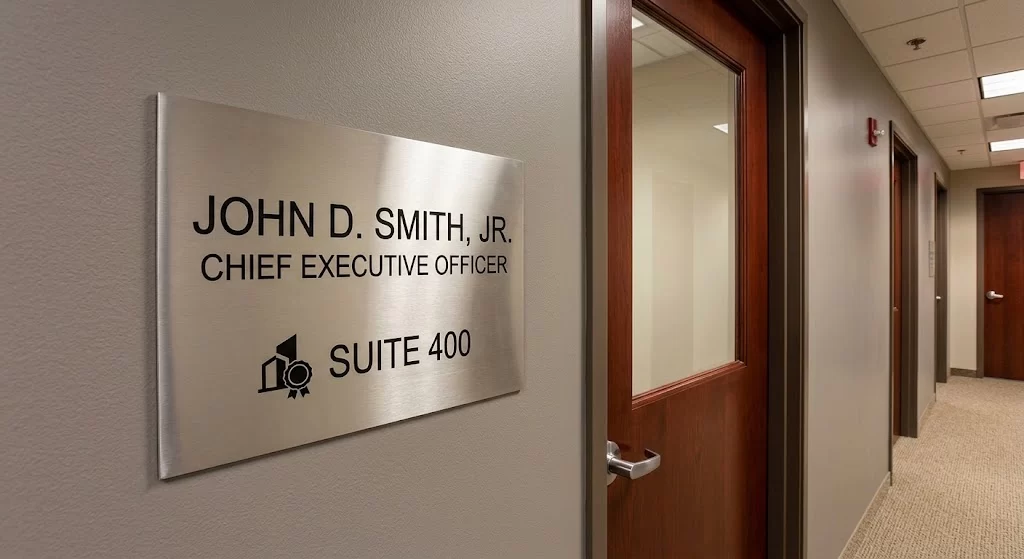
3. Office Door Signs and Nameplates
Office door signs and nameplates identify individual offices, meeting rooms, and workspaces, typically displaying the occupant’s name, title, department, and sometimes a room number. Office door signs are commonly made of aluminum (the most common, cost-effective, and modern choice), acrylic (a colorful, modern alternative), or brass/bronze (a traditional, premium choice for executive offices or professional firms). Office door signs may be engraved (with paint-filled or laser-engraved text) or printed (with vinyl or digital graphics), and they may be ADA-compliant (with tactile characters and Grade 2 Braille) if they identify permanent rooms or spaces (as required by the ADA). Office door signs are typically mounted on the wall adjacent to the door (latch side, at 48–60″ height for ADA compliance) or on the door itself.
Key considerations: For permanent room identification signs (offices, meeting rooms, restrooms), ensure the sign is ADA-compliant (tactile characters, Grade 2 Braille, non-glare finish, 70% contrast, mounted at 48–60″ height on the latch side of the door). Our ADA signage guide provides detailed specifications. For occupant nameplates that may change frequently (e.g., in offices with high turnover), consider using changeable insert signs or modular sign systems that allow names to be updated without replacing the entire sign. Ensure consistent design across all office signs (same materials, colors, typography, layout) for a professional, cohesive appearance. Choose a material and finish that complements the office interior design and furniture.
4. Room Identification and Wayfinding Signs
Room identification signs identify permanent rooms and spaces in commercial, institutional, and public buildings (offices, hospitals, schools, universities, government buildings, hotels), including restrooms, conference rooms, break rooms, storage rooms, mechanical rooms, laboratories, and patient rooms—see our guide to medical clinic and dental office signage for healthcare room identification. Wayfinding signs guide visitors and employees through the building, including directional signs, directory signs, floor identification signs, and informational signs. Room identification and wayfinding signs are commonly made of aluminum (the most common, durable, and cost-effective choice), acrylic (a colorful, modern alternative), or phenolic/micarta (a durable, layered plastic commonly used in healthcare and institutional settings). These signs are typically engraved (with paint-filled or laser-engraved text and icons) or printed (with vinyl or digital graphics), and permanent room identification signs must be ADA-compliant (with tactile characters and Grade 2 Braille).
Key considerations: Ensure all permanent room identification signs are ADA-compliant (tactile characters, Grade 2 Braille, non-glare finish, 70% contrast, mounted at 48–60″ height on the latch side of the door). Develop a consistent signage system (same materials, colors, typography, layout, iconography) across all room identification and wayfinding signs for a cohesive, professional appearance and easy navigation. Use color-coding by department or floor (if applicable) to help visitors navigate large or complex buildings. Ensure wayfinding signs are placed at all decision points (entrances, lobbies, corridor intersections, elevator lobbies, stairwells) with clear, concise directions. Choose durable, easy-to-clean materials (aluminum, phenolic, acrylic) for high-traffic or healthcare environments, where hygiene and durability are important.
5. Awards, Recognition, and Achievement Plaques
Award and recognition plaques are presented to individuals or organizations to honor achievements, milestones, service, or contributions, commonly in corporate, non-profit, educational, sports, and community settings. Award plaques typically include the name of the recipient, the award or achievement being recognized, the date, the presenting organization’s name/logo, and sometimes a brief inscription or quote. Award plaques are commonly made of wood (the traditional, warm choice, often with a metal plate), acrylic (a modern, colorful, and affordable alternative), metal (aluminum, brass, bronze, stainless steel for a premium, durable award), or glass/stone (for high-end, prestigious awards). Award plaques may be engraved (with paint-filled or laser-engraved text) or printed (with full-color graphics or photographs), and they are typically presented in a presentation box or with a stand for display.
Key considerations: Choose a material and style that reflects the significance of the award and the organization’s brand (e.g., bronze or granite for prestigious, lifetime achievement awards; wood or acrylic for more casual, frequent recognition awards). Ensure the recipient’s name, award title, date, and inscription are accurate and properly proofread before engraving (errors on an award plaque are embarrassing and may require re-fabrication). Consider including the organization’s logo and/or a photograph or image to personalize the award. For large orders (e.g., annual awards for multiple recipients), ensure consistent quality and design across all plaques, and choose a manufacturer with experience in high-volume award production. Consider the presentation and display of the award (e.g., include a presentation box, stand, or hanging hardware) to enhance the recipient’s experience and make the award easy to display.
6. Historical Markers and Interpretive Plaques
Historical markers and interpretive plaques are installed in public spaces (parks, historic buildings, sidewalks, trails) to provide information about historical events, people, places, or natural features, commonly used by historical societies, government agencies, non-profit organizations, and educational institutions. Historical markers typically include the name of the historical site or event, a brief description of its historical significance, dates, and the name of the sponsoring organization. Interpretive plaques may include more detailed information, maps, photographs, or illustrations to educate visitors about the site. Historical markers and interpretive plaques are typically made of bronze (the traditional, durable choice for outdoor historical markers), aluminum (a cost-effective, modern alternative), or granite (for permanent, monument-style markers), and they are installed on a wall, post, pedestal, or monument in a visible, accessible location.
Key considerations: Choose a durable, weather-resistant material (bronze, aluminum, or granite) that will withstand outdoor conditions and require minimal maintenance. Ensure the historical information is accurate, well-researched, and properly reviewed by historians or subject matter experts before engraving (errors on a public historical marker are embarrassing and may require re-fabrication). Write the text in a clear, concise, accessible style that is easy for the general public to read and understand (avoid jargon or overly academic language). Consider including a photograph, map, or illustration (for laser-engraved or printed plaques) to enhance the educational value and visual appeal. Ensure the plaque is installed in a visible, accessible location with adequate lighting (for nighttime visibility) and protection from vandalism or theft. Comply with any local regulations or permitting requirements for installing historical markers or interpretive plaques in public spaces.
7. Equipment and Asset Identification Labels
Equipment and asset identification labels are used to identify, track, and manage equipment, machinery, furniture, and assets in commercial, industrial, and institutional settings (offices, factories, warehouses, hospitals, universities, government buildings). These labels typically include the asset name/ID number, serial number, purchase date, department, and sometimes a barcode or QR code for inventory tracking. Equipment labels are commonly made of aluminum (the most durable, weather-resistant, and cost-effective choice), stainless steel (for harsh or corrosive environments), acrylic (for indoor, low-wear applications), or laminated vinyl (for temporary or low-cost applications). These labels are typically laser engraved (on anodized or powder-coated aluminum) or printed (with barcodes, QR codes, or variable data), and they are mounted to the equipment using adhesive, screws, or rivets.
Key considerations: Choose a material that is durable enough for the equipment’s environment (e.g., stainless steel for outdoor or corrosive industrial environments; anodized aluminum for general indoor/outdoor use; laminated vinyl for temporary or low-wear indoor applications). Ensure the label is resistant to chemicals, cleaning agents, and abrasion, particularly for equipment in industrial, healthcare, or food processing environments where frequent cleaning is required. Include variable data (asset ID numbers, barcodes, QR codes, serial numbers) as needed for inventory tracking and management. Ensure the label is securely mounted to the equipment using an appropriate adhesive (for smooth surfaces) or mechanical fasteners (screws, rivets for high-wear or outdoor applications). Comply with any regulatory requirements for equipment labeling (e.g., OSHA requirements for hazard identification, FDA requirements for medical equipment, ISO requirements for asset management).
Design Best Practices for Engraved Signs and Plaques
A well-designed engraved sign or plaque is readable, professional, and appropriate for its intended use and environment. The following design best practices will help you create a high-quality, effective engraved sign or plaque that meets your needs and expectations:
1. Prioritize Readability and Contrast
The primary purpose of an engraved sign or plaque is to communicate information, so prioritize readability and contrast in all design decisions:
- High contrast between text and background: Ensure the engraved text provides adequate contrast with the background material for readability in all lighting conditions. For paint-filled engraving, use a high-contrast paint color (e.g., black paint on bronze or brass, white paint on dark aluminum or stainless steel, black paint on light wood). For laser engraving on anodized aluminum, choose a coating color that provides high contrast with the underlying aluminum (e.g., black anodized aluminum engraves to silver/white, providing high contrast; silver anodized aluminum engraves to dark gray/black, also providing good contrast). For stone or wood engraving, the natural contrast between the polished/smooth surface and the textured/engraved area may be sufficient, but paint-filling can enhance contrast for low-contrast materials.
- Appropriate text size: Choose a text size that is readable from the intended viewing distance. As a general rule, 1 inch of text height is readable from approximately 30–50 feet, but for engraved signs (which may have lower contrast than printed signs), err on the side of larger text. For plaques viewed from 3–10 feet away (the typical viewing distance for wall-mounted plaques), text should be at least 1/4″–1/2″ tall for body text and 1/2″–1″ tall for headings or names. For plaques viewed from a greater distance (e.g., outdoor historical markers), use larger text (1″–2″ tall for headings, 1/2″–3/4″ tall for body text).
- Simple, legible typography: Use simple, legible, sans-serif fonts (e.g., Helvetica, Arial, Futura, Gotham) for engraved text, particularly for small text or detailed designs. Avoid decorative, script, or thin fonts that may be difficult to engrave clearly or read from a distance. For headings or names (which are typically larger), a serif font (e.g., Times New Roman, Garamond, Trajan) may be used for a traditional, elegant appearance, but ensure the font is still legible when engraved. Use bold or medium font weights for better contrast and readability, particularly for small text.
- Adequate spacing: Ensure adequate spacing between letters (kerning), words, and lines of text to improve readability and prevent the text from appearing crowded or difficult to read. For engraved text, slightly increased letter spacing (compared to printed text) can improve readability, as the engraved grooves may appear to merge if letters are too close together. Ensure adequate margin (blank space) around the text (typically 10–20% of the plaque width/height) to prevent the text from appearing cramped and to provide a clean, professional appearance.
2. Keep the Design Simple and Focused
Engraved signs and plaques are most effective when the design is simple, focused, and not overcrowded with too much text or too many graphic elements:
- Limit text to essential information: Include only the essential information on the plaque (e.g., for a dedication plaque: building name, date, key names; for a memorial: name, dates, brief inscription; for an office sign: name, title, room number). Avoid including excessive text, long paragraphs, or unnecessary details that will make the plaque difficult to read and cluttered. If more detailed information is needed (e.g., for an interpretive plaque), use a larger plaque and organize the text into clear, concise sections with headings.
- Use a clear visual hierarchy: Organize the text and graphic elements in a clear visual hierarchy, with the most important information (e.g., name, title, building name) in the largest, most prominent text, and secondary information (e.g., dates, inscriptions, organization name) in smaller, less prominent text. Use headings, subheadings, and body text sizes to guide the reader’s eye and make the information easy to scan and understand.
- Limit graphic elements: Include only one or two graphic elements (e.g., a logo, icon, or border) on the plaque, and ensure they are simple, recognizable, and do not distract from the text. Avoid complex, detailed graphics or photographs that may be difficult to reproduce clearly when engraved (particularly for rotary engraving or sandblasting, which have limited detail capability). If a logo is included, ensure it is simple enough to engrave clearly and that it is sized appropriately (not too large to dominate the plaque, not too small to be recognizable).
- Use borders and frames sparingly: A simple border or frame can enhance the appearance of a plaque and provide a clean, finished look, but avoid overly complex or decorative borders that may distract from the text or be difficult to engrave. A simple, thin border (1/8″–1/4″ wide) around the perimeter of the plaque is sufficient for most applications; for a more traditional or ornate look, a double border or decorative corner elements may be used, but ensure they do not overwhelm the text.
3. Choose the Right Material and Finish for the Application
The material and finish of the plaque should be appropriate for its intended use, environment, and desired aesthetic:
- Indoor vs. outdoor: For outdoor applications, choose a durable, weather-resistant material (bronze, stainless steel, anodized aluminum, granite) that will withstand rain, snow, UV radiation, and temperature extremes with minimal maintenance. For indoor applications, a wider range of materials is suitable (including brass, acrylic, wood, glass), as they are protected from the elements. For covered or semi-outdoor applications (e.g., under an awning or overhang), choose a material that is resistant to moisture and UV exposure but may not need the same level of durability as a fully exposed outdoor plaque.
- High-traffic vs. low-traffic: For high-traffic or abusive environments (e.g., public spaces, schools, industrial settings), choose a durable, scratch-resistant material (stainless steel, anodized aluminum, granite) that will withstand frequent contact, cleaning, and potential impact. For low-traffic or controlled environments (e.g., executive offices, lobbies, private residences), a wider range of materials is suitable (including brass, acrylic, wood, glass), as they are less likely to be damaged.
- Traditional vs. modern aesthetic: Choose a material and finish that matches the desired aesthetic and the surrounding environment. For traditional, historic, or formal environments (e.g., government buildings, universities, historic properties, law firms), bronze, brass, or wood with a traditional finish (polished, patinated, stained) is appropriate. For modern, contemporary, or corporate environments (e.g., tech companies, modern offices, healthcare facilities), stainless steel, anodized aluminum, or acrylic with a modern finish (brushed, matte, glossy) is appropriate. For rustic or artisanal environments (e.g., restaurants, cafes, lodges), wood or stone with a natural finish is appropriate.
- Brand consistency: For commercial or institutional applications, ensure the plaque material, color, and finish are consistent with the organization’s brand identity and other signage in the building or facility. Use brand-approved colors, fonts, and logo versions, and ensure the plaque design is consistent with other signs (room identification, wayfinding, directional) for a cohesive, professional appearance.
4. Ensure Accuracy and Proofread Carefully
Engraved signs and plaques are permanent, and errors (misspelled names, incorrect dates, wrong titles) are embarrassing and costly to correct (often requiring re-fabrication of the entire plaque). Ensure accuracy by proofreading carefully before fabrication:
- Verify all names, dates, and titles: Double-check all names (spelling, middle initials, suffixes), dates (day, month, year), titles (job titles, honorifics), and other factual information for accuracy. If the plaque honors specific individuals, obtain written confirmation of the correct spelling of their names and titles before fabrication.
- Proofread the text multiple times: Proofread the entire plaque text multiple times, including a final read-through after the design is complete (it is easy to miss errors when you are familiar with the text). Have someone else (who is not familiar with the text) proofread it as well, as they may catch errors you missed. Read the text aloud to catch awkward phrasing or errors that may not be apparent when reading silently.
- Verify logo and graphic accuracy: Ensure the logo or graphic is the correct version, properly proportioned, and free of errors or distortions. If the logo includes text (e.g., a tagline), proofread that text as well. Ensure the logo is high-resolution and suitable for engraving (vector format is preferred; low-resolution raster images may not reproduce clearly when engraved).
- Obtain final approval before fabrication: Obtain written final approval from all relevant stakeholders (e.g., the building owner, the honoree, the organization’s leadership, the design team) before fabrication begins. Provide a digital proof or mockup of the plaque design for review and approval, and ensure all parties have confirmed the accuracy of the text, design, and material before the plaque is engraved.
5. Consider Installation and Long-Term Maintenance
When designing an engraved sign or plaque, consider how it will be installed and maintained over its lifetime:
- Mounting method: Choose a mounting method that is appropriate for the plaque material, size, weight, and installation surface (wall, post, pedestal, monument). For small, lightweight plaques (aluminum, acrylic, wood), adhesive mounting (with heavy-duty construction adhesive) or screw mounting (with decorative screw caps) may be sufficient. For large, heavy plaques (bronze, stainless steel, stone), use robust mechanical fasteners (stainless steel screws, bolts, or threaded studs) with appropriate wall anchors (for drywall, concrete, brick, stone) or structural backing (for fragile or non-structural wall materials). For outdoor or public installations, consider security mounting hardware (tamper-proof screws, threaded studs with epoxy) to prevent theft or vandalism, particularly for bronze or brass plaques (which have scrap value).
- Installation location and height: Install the plaque at a height and location that is visible, accessible, and appropriate for its intended use. For wall-mounted plaques (dedications, memorials, office signs), install at eye level (typically 55–65 inches from the floor to the center of the plaque) for easy reading. For outdoor historical markers or interpretive plaques, install in a visible, accessible location with adequate lighting (for nighttime visibility) and protection from the elements (if possible). For ADA-compliant room identification signs, install at 48–60 inches from the floor to the baseline of the lowest tactile character, on the latch side of the door (as required by the ADA).
- Long-term maintenance: Choose a material and finish that requires minimal maintenance for the intended environment, and provide the owner with maintenance instructions (cleaning products, frequency, protective coatings) to ensure the plaque remains in good condition. For bronze or brass plaques (which may tarnish or patina over time), decide whether to preserve a polished finish (requiring periodic cleaning and polishing) or allow a natural patina to develop (requiring minimal maintenance). For painted or powder-coated plaques, ensure the finish is durable and UV-resistant, and plan for periodic touch-ups or refinishing if the finish becomes damaged or faded. For stone or stainless steel plaques (which require minimal maintenance), periodic cleaning with water and a mild detergent is sufficient to maintain their appearance.
- Future updates or changes: If the plaque information may change in the future (e.g., office occupant name, equipment asset ID), consider using a changeable insert system or modular sign design that allows the text to be updated without replacing the entire plaque. For permanent plaques (dedications, memorials, historical markers), ensure the information is timeless and will not need to be updated, as changes to a permanent engraved plaque are difficult and costly.
Hongbo Sign Engraved Sign and Plaque Manufacturing
At Hongbo Sign, we design and manufacture high-quality custom engraved signs and plaques for professional offices, buildings, institutions, and public spaces. With over a decade of experience in commercial signage manufacturing and a wide range of engraving methods (laser, rotary, chemical etching, sandblasting), materials (bronze, brass, aluminum, stainless steel, acrylic, wood, stone), and custom design capabilities, we can create an engraved sign or plaque that perfectly matches your requirements, budget, and aesthetic preferences.
- Comprehensive engraving capabilities: We offer a full range of engraving methods, including laser engraving (for detailed, precise designs on wood, acrylic, coated metals, and some uncoated metals with marking compound), rotary/CNC engraving (for deep, tactile engraving in metals, plastics, and wood), chemical etching (for high-quality, detailed engraving in bronze, brass, stainless steel, and copper), and sandblasting (for large-format engraving in stone, glass, and metal). We can recommend the best engraving method for your specific material, design, and application, ensuring the highest quality and most cost-effective result.
- Wide range of materials: We offer a full range of plaque materials, including bronze (cast and sheet), brass, aluminum (anodized, powder-coated, brushed, polished), stainless steel (304/316, brushed, polished, bead-blasted, powder-coated), acrylic (clear, translucent, opaque, colored, UV-stabilized), wood (oak, maple, cherry, walnut, mahogany, cedar, bamboo), and stone (granite, marble, limestone). We can help you choose the right material for your specific application, environment, and budget, and we can provide material samples for your review and approval before fabrication.
- Custom design services: We offer fully custom engraved sign and plaque design, including custom sizes, shapes, layouts, fonts, colors, borders, and graphic elements. Our in-house design team can work with your brand guidelines, existing signage, or architectural specifications to create a plaque design that is consistent with your organization’s identity and complements the surrounding environment. We provide digital proofs and mockups for your review and approval before fabrication, ensuring the final plaque matches your expectations.
- Graphic application expertise: We offer a full range of graphic application methods for engraved plaques, including paint-filled engraving (with enamel or epoxy paint in a wide range of colors), laser-engraved graphics (producing a high-contrast mark on coated metals, wood, or acrylic), chemical-etched graphics (with paint-filled or natural patina contrast), sandblasted graphics (with natural texture contrast or paint filling), and printed graphics (full-color digital printing or vinyl graphics for complex logos or photographs). We can recommend the best graphic application method for your specific design, material, and durability requirements.
- ADA-compliant engraved signage: We manufacture ADA-compliant engraved room identification signs with tactile characters and Grade 2 Braille, meeting all applicable ADA Standards for Accessible Design (character height, stroke width, proportion, Braille specifications, mounting height/location, contrast, non-glare finish). Our ADA signage guide provides detailed specifications, and we can help you ensure your engraved room signs are fully ADA-compliant.
- Multi-location and high-volume capability: Whether you need a single dedication plaque for a new building or hundreds of engraved office signs and nameplates for a multi-location corporate or institutional rollout, we have the production capacity and project management systems to deliver consistent, high-quality engraved signage across all locations. We offer centralized project management, coordinated production and shipping schedules, brand consistency controls, and bulk pricing for large orders.
- Durable, high-quality construction: All our engraved signs and plaques are constructed from commercial-grade, durable materials using high-quality fabrication and engraving techniques, ensuring a long-lasting, professional appearance that will withstand the test of time. We use high-quality paints and coatings for paint-filled engraving (resistant to fading, chipping, and weathering), and we ensure all engravings are clean, precise, and consistent across the entire plaque. We provide detailed maintenance instructions and replacement/repair services for all our engraved products.
- Installation support and hardware: We provide comprehensive installation instructions, mounting hardware (screws, bolts, anchors, decorative screw caps, security fasteners), and technical support for your local installer. For large or heavy plaques (bronze, stainless steel, stone), we can provide structural mounting recommendations and custom hardware to ensure safe, secure installation. For outdoor or public installations, we offer security mounting hardware (tamper-proof screws, threaded studs with epoxy) to prevent theft or vandalism.
- Competitive factory-direct pricing: As a direct manufacturer, we offer competitive factory-direct pricing with no middleman markup. We provide transparent, itemized quotations with no hidden fees, and we can work with you to find cost-effective solutions that meet your budget without compromising quality, durability, or aesthetic appeal. We offer volume discounts for large orders and multi-location rollouts.
We understand that engraved signs and plaques are permanent, meaningful investments that convey professionalism, prestige, and respect, and we are committed to delivering the highest quality products that will stand the test of time. From initial design and proofing to fabrication, quality control, shipping, and after-sales support, we are with you every step of the way.
Ready to commission a custom engraved sign or bronze plaque for your office, building, or institution? Contact us today for a free consultation and factory-direct quote. Our design team will work with you to create a beautiful, durable, and meaningful engraved sign or plaque that meets your exact requirements and exceeds your expectations.

Frequently Asked Questions
Q: What are engraved signs and bronze plaques used for?
A: Engraved signs and bronze plaques are used for professional building identification, corporate lobbies, government buildings, educational institutions, memorials, donor recognition, historical markers, directory signs, and commemorative installations. They convey permanence, prestige, and professionalism, and are designed to last for decades with minimal maintenance.
Q: How long do bronze plaques last?
A: Bronze plaques are extremely durable and can last 50–100 years or more outdoors. Bronze naturally develops a protective patina over time that prevents further corrosion. Cast bronze plaques are the most durable option, while etched or engraved bronze offers finer detail. Proper installation and occasional cleaning help maintain appearance, but bronze is essentially maintenance-free for most applications.
Q: Can engraved signs be illuminated?
A: Yes, engraved signs can be illuminated through several methods. Edge-lit acrylic engraved signs use LEDs along the edge to illuminate engraved lines from within. Backlit engraved signs use LEDs behind a translucent panel. Bronze and metal plaques can be illuminated with external spotlights or integrated LED lighting. The best illumination method depends on the material, location, and desired visual effect.