

Overview of the US Commercial Signage Market
The United States commercial signage market is one of the largest and most mature signage markets in the world, encompassing a wide range of sign types—from traditional storefront signs, channel letters, and monument signs to modern digital LED displays, interactive kiosks, and smart signage systems. The US market is characterized by high demand for quality, innovation, and regulatory compliance, driven by a large and diverse commercial real estate sector, a vibrant retail and hospitality industry, ongoing construction and renovation activity, and increasing demand for digital and interactive signage solutions. For sign buyers, importers, and manufacturers, understanding the US commercial signage market—its size, growth drivers, demand trends, regulatory landscape, sourcing dynamics, and technology trends—is essential for making informed decisions, identifying opportunities, and navigating the complexities of this large and competitive market.
The US commercial signage market has experienced steady growth over the past decade, driven by several key factors: ongoing commercial construction and renovation activity (particularly in retail, hospitality, healthcare, and corporate sectors), increasing demand for digital and LED signage (driven by falling technology costs and growing recognition of digital signage’s marketing effectiveness), regulatory requirements (ADA accessibility, building codes, energy efficiency standards) that drive sign replacement and upgrades, and a growing emphasis on brand experience and customer engagement (which increases investment in high-quality, innovative signage). The COVID-19 pandemic temporarily disrupted the market in 2020 (due to construction delays, business closures, and reduced advertising spending), but the market has since recovered strongly, driven by pent-up demand, increased construction activity, and growing demand for digital and health/safety signage.
This article provides an in-depth analysis of the US commercial signage market, covering market size and growth drivers, demand trends by industry segment, the regulatory landscape (federal, state, local), ADA and building code requirements, sourcing trends (domestic vs. offshore manufacturing, China sourcing), technology trends (LED, digital signage, smart signage), and opportunities and challenges for sign buyers and importers. Whether you are a US business owner sourcing signage for your facility, a sign importer or distributor looking to understand the market, or a manufacturer seeking to enter or expand in the US market, this analysis will provide valuable insights and actionable information.
Market Size and Growth Drivers
Market Size and Segmentation
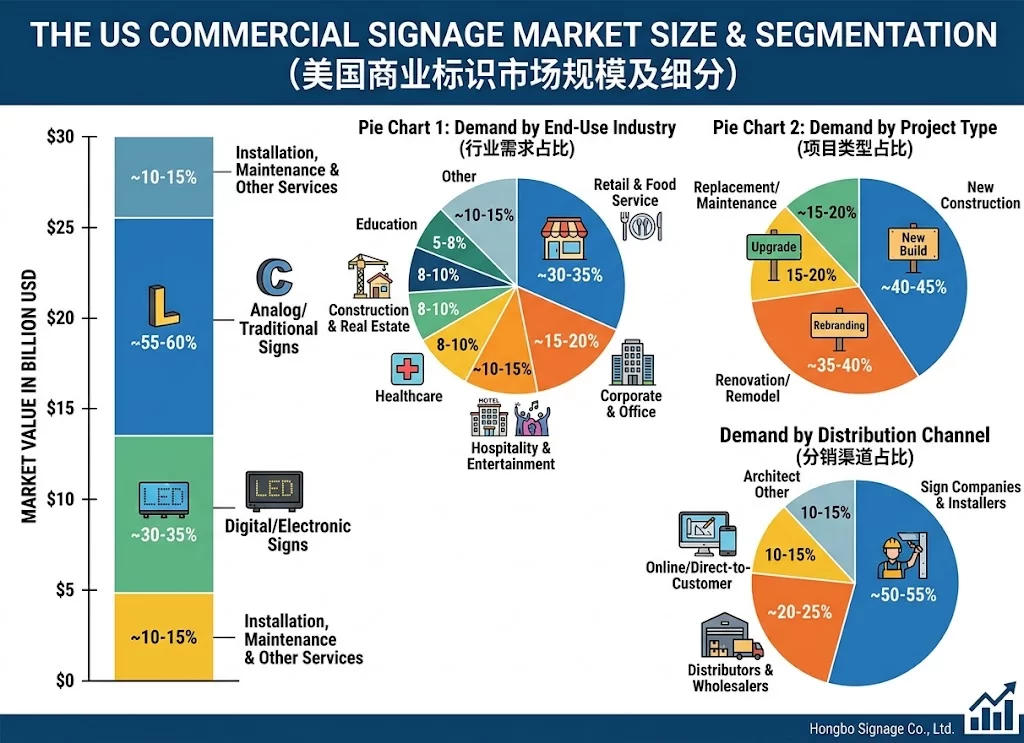
The US commercial signage market is valued at approximately $15–20 billion annually (including all sign types, manufacturing, installation, and maintenance services), with the broader North American signage market (including Canada and Mexico) valued at approximately $20–25 billion. The market can be segmented in several ways:
- By sign type: Traditional/analog signs (channel letters, monument signs, blade signs, awnings, banners, dimensional letters) account for approximately 55–60% of the market; digital/electronic signs (LED displays, digital menu boards, interactive kiosks, video walls) account for approximately 30–35% of the market; and other sign products and services (installation, maintenance, design, consulting) account for approximately 10–15% of the market. The digital signage segment is the fastest-growing, with annual growth rates of 8–12%, while the traditional sign segment grows at a more moderate 2–4% annually.
- By end-use industry: Retail (including restaurants, food service, and storefronts) is the largest segment, accounting for approximately 30–35% of commercial signage demand; corporate and office buildings account for approximately 15–20%; hospitality (hotels, resorts, entertainment venues) accounts for approximately 10–15%; healthcare accounts for approximately 8–10%; construction and real estate accounts for approximately 8–10%; education accounts for approximately 5–8%; and other industries (transportation, government, religious, industrial) account for the remaining 10–15%.
- By project type: New construction signage (signs for newly built facilities) accounts for approximately 40–45% of the market; renovation/remodel signage (signs for facility renovations, rebranding, or upgrades) accounts for approximately 35–40% of the market; and replacement/maintenance signage (signs replacing old, damaged, or non-compliant signs, plus ongoing maintenance services) accounts for approximately 15–20% of the market.
- By distribution channel: Sign companies and installers (local, regional, national) account for approximately 50–55% of sign sales (providing design, fabrication, installation, and maintenance services); sign distributors and wholesalers account for approximately 20–25%; online and direct-to-customer sales account for approximately 10–15% (growing rapidly due to e-commerce and digital sign configuration tools); and other channels (architects, general contractors, facility management companies) account for approximately 10–15%.
Key Growth Drivers
The US commercial signage market is driven by several key factors that are expected to continue supporting market growth in the coming years:
- Commercial construction and renovation activity: Ongoing commercial construction (new retail centers, office buildings, hotels, hospitals, schools) and renovation activity (remodeling of existing facilities, rebranding, tenant improvements) is the primary driver of signage demand, as every new or renovated commercial facility requires signage (exterior identification, interior wayfinding, regulatory, digital). While construction activity fluctuates with economic cycles, the long-term trend is positive, driven by population growth, urbanization, and ongoing investment in commercial infrastructure.
- Digital signage adoption and innovation: The rapid adoption of digital signage (LED displays, digital menu boards, video walls, interactive kiosks) is a major growth driver, as businesses increasingly recognize the marketing and communication benefits of digital signage (real-time content updates, dynamic and engaging content, targeted messaging, data and analytics, integration with other technologies). Falling technology costs, improving display quality, and growing content management software capabilities are making digital signage accessible to a wider range of businesses, from small restaurants to large corporate campuses. The digital signage segment is expected to continue growing at 8–12% annually, outpacing the traditional sign segment.
- Regulatory requirements and compliance: Regulatory requirements—including ADA accessibility standards (requiring tactile/Braille signage for permanent rooms and spaces), building and fire codes (requiring exit signs, emergency lighting, and egress signage), energy efficiency standards (driving adoption of LED lighting and high-efficiency signage), and local sign codes (regulating sign size, height, illumination, and placement)—drive ongoing demand for sign replacement, upgrades, and new installations. As regulations evolve and enforcement increases, businesses must invest in compliant signage, creating steady demand for sign manufacturers and installers.
- Brand experience and customer engagement: Businesses are increasingly investing in their physical spaces and brand experiences to attract and retain customers, and signage plays a critical role in creating a cohesive, engaging, and memorable brand experience. From eye-catching storefront signs and interactive digital displays to cohesive wayfinding systems and branded environmental graphics, signage helps businesses differentiate themselves, communicate their brand identity, and create a positive customer experience. This trend is particularly strong in retail, hospitality, healthcare, and corporate sectors, where competition for customer attention and loyalty is intense.
- E-commerce and omnichannel retail: The growth of e-commerce and omnichannel retail is changing the role of physical retail spaces, with stores increasingly serving as showrooms, experience centers, and brand touchpoints rather than just transactional spaces. This shift is driving investment in high-quality, innovative signage (digital displays, interactive kiosks, experiential signage) that enhances the in-store experience, bridges the online-offline gap, and supports omnichannel strategies (e.g., buy online pick up in store (BOPIS) signage, interactive product displays, digital wayfinding).
- Energy efficiency and sustainability: Growing emphasis on energy efficiency and sustainability is driving demand for LED signage (which uses 50–80% less energy than traditional neon or fluorescent signage), solar-powered signage, recyclable materials (aluminum, recycled plastics), and eco-friendly manufacturing processes. Many businesses and government entities are setting sustainability goals and requiring environmentally friendly signage, creating opportunities for manufacturers that offer energy-efficient and sustainable products. LED signage has already largely replaced neon and fluorescent signage in new installations, and the trend toward energy efficiency is expected to continue driving replacement of older, less efficient signage.
- Smart city and IoT integration: The growth of smart city initiatives and Internet of Things (IoT) technology is creating new opportunities for connected, intelligent signage systems that integrate with other city systems (traffic management, public safety, transit, environmental monitoring). Smart signage can provide real-time information (transit schedules, emergency alerts, weather, event updates), collect data (foot traffic, customer behavior, environmental conditions), and integrate with mobile devices and other smart systems. While still in the early stages of adoption, smart signage is expected to be a significant growth area in the coming years, particularly for government, transportation, and large campus applications.
Demand Trends by Industry Segment
Retail and Food Service
Retail (including restaurants, food service, and storefronts) is the largest segment of the US commercial signage market, accounting for approximately 30–35% of total demand. Key trends in this segment include:
- Storefront signage upgrades: Retailers and restaurants are investing in high-quality, eye-catching storefront signage (channel letters, monument signs, blade signs, awnings) to attract foot traffic, differentiate from competitors, and create a strong brand identity. The trend toward experiential retail and brand experience is driving demand for innovative, custom-designed storefront signage that reflects the brand’s personality and creates a memorable first impression.
- Digital menu boards and in-store digital signage: Restaurants, fast-food chains, cafes, and food service businesses are rapidly adopting digital menu boards (replacing static menu boards) to enable real-time menu updates, dynamic pricing, promotional content, and engaging visual displays. In-store digital signage (endcap displays, promotional screens, interactive kiosks) is also growing, as retailers use digital displays to promote products, provide information, and enhance the shopping experience. The restaurant digital menu board market is particularly strong, with major fast-food chains (McDonald’s, Burger King, Taco Bell, etc.) completing company-wide digital menu board rollouts and smaller chains and independent restaurants following suit.
- Omnichannel and BOPIS signage: As retailers adopt omnichannel strategies (buy online pick up in store, curbside pickup, ship from store), they are investing in signage to support these services, including BOPIS/curbside pickup signs, parking spot identification, directional signage, and digital order status displays. This trend accelerated during the COVID-19 pandemic and is expected to continue as omnichannel retail becomes the norm.
- Rebranding and franchise rollouts: Retail and restaurant chains frequently rebrand (updating logos, colors, store design) or expand (opening new locations, acquiring other chains), driving large-scale signage rollouts across multiple locations. Franchise expansion is particularly strong in the fast-food, fast-casual, and convenience store sectors, creating steady demand for standardized, high-quality signage that can be efficiently produced and installed across many locations.
- Small business signage demand: The US has a large and growing number of small businesses (independent retailers, restaurants, service businesses), many of which need affordable, high-quality signage for their storefronts. The growth of e-commerce and online sign configuration tools is making it easier for small businesses to design and order custom signage, driving growth in the small business segment. This segment is particularly price-sensitive and values fast turnaround, easy online ordering, and affordable shipping.
Corporate and Office
Corporate and office buildings account for approximately 15–20% of US commercial signage demand. Key trends include:
- Corporate campus wayfinding and identification: Large corporate campuses (technology companies, financial institutions, healthcare systems, universities) require comprehensive wayfinding and identification signage systems (exterior building identification, interior directories, directional signs, room identification, ADA-compliant signage) to guide employees, visitors, and clients through complex facilities. The trend toward larger, more complex corporate campuses (particularly in technology, healthcare, and education sectors) is driving demand for sophisticated, cohesive wayfinding systems that integrate digital and analog signage.
- Lobby and reception signage: Companies are investing in high-quality lobby and reception signage (3D letters, logo walls, digital displays, environmental graphics) to create a professional, impressive first impression for visitors and reinforce brand identity. The trend toward brand experience and workplace design is driving demand for custom, innovative lobby signage that reflects the company’s culture and values.
- Hybrid work and office reconfiguration: The shift toward hybrid work (combining remote and in-office work) is driving office reconfiguration and renovation, as companies redesign their offices to support collaboration, flexibility, and employee experience. This renovation activity includes signage upgrades (new room identification, wayfinding, digital directory displays, meeting room signage, hoteling/desk booking signage) to support the new office layout and hybrid work model.
- ESG and sustainability reporting: Companies are increasingly focused on environmental, social, and governance (ESG) goals and sustainability reporting, and they are seeking energy-efficient, sustainable signage (LED lighting, recyclable materials, low-VOC manufacturing) to support their sustainability objectives. This trend is particularly strong for large corporations with public sustainability commitments, and it is driving demand for signage manufacturers that can provide eco-friendly products and sustainability documentation.
Hospitality and Entertainment
Hospitality (hotels, resorts, restaurants, entertainment venues) accounts for approximately 10–15% of US commercial signage demand. Key trends include:
- Hotel and resort signage systems: Hotels and resorts require comprehensive signage systems (exterior identification, pylon/monument signs, entrance canopies, interior wayfinding, room identification, directional signs, ADA-compliant signage, digital directories, event signage) to guide guests through large, complex facilities and create a premium, welcoming experience. The recovery of the travel and hospitality industry following the COVID-19 pandemic has driven increased hotel construction and renovation, and with it, increased demand for high-quality, innovative hotel signage.
- Experiential and immersive signage: Entertainment venues (theaters, stadiums, arenas, theme parks, museums, casinos) are investing in experiential and immersive signage (large-scale video walls, LED displays, interactive exhibits, projection mapping, dynamic lighting) to create memorable, engaging experiences for visitors. The trend toward experiential entertainment and the growing competition for consumer attention are driving demand for innovative, high-impact signage and display solutions in this segment.
- Restaurant and bar signage: Restaurants, bars, and nightlife venues use signage extensively for branding (storefront signs, blade signs, awnings), wayfinding (restroom signs, directional signs, table numbers), menu display (digital menu boards, chalkboard signs, backlit menus), and atmosphere (neon signs, LED lighting, decorative signage). The growth of the restaurant industry and the trend toward restaurant design and brand experience are driving demand for creative, custom-designed restaurant signage.
- Event and temporary signage: The hospitality and events industry requires a wide range of temporary and event signage (banners, step-and-repeat backdrops, directional signs, table tents, name badges, digital event displays) for conferences, weddings, trade shows, concerts, and other events. The recovery of the events industry following the COVID-19 pandemic has driven increased demand for event signage, and the trend toward hybrid and virtual events is creating new opportunities for digital and interactive event signage.
Healthcare
Healthcare (hospitals, clinics, dental offices, medical centers, senior care facilities) accounts for approximately 8–10% of US commercial signage demand. Key trends include:
- Healthcare wayfinding and patient experience: Healthcare facilities are large, complex, and often stressful environments for patients and visitors, and effective wayfinding signage is critical for reducing stress, improving efficiency, and enhancing the patient experience. Healthcare facilities require comprehensive signage systems (exterior identification, interior directories, directional signs, department identification, room identification, ADA-compliant tactile/Braille signage, digital wayfinding kiosks, color-coded wayfinding systems) to guide patients, visitors, and staff through the facility. The trend toward patient-centered care and patient experience improvement is driving investment in high-quality, user-friendly healthcare wayfinding systems.
- Regulatory and compliance signage: Healthcare facilities are subject to extensive regulatory requirements, including ADA accessibility (tactile/Braille signage, accessible routes, visual fire alarms), HIPAA privacy (signage protecting patient privacy), OSHA workplace safety (hazard signage, safety notices), NFPA fire safety (exit signs, emergency lighting, evacuation maps), and state-specific healthcare regulations. Compliance with these regulations drives ongoing demand for compliant signage and sign upgrades, particularly as regulations evolve and enforcement increases.
- Digital signage for communication and engagement: Healthcare facilities are increasingly using digital signage (waiting room displays, digital directories, wayfinding kiosks, patient check-in displays, health education screens, emergency alert displays) to communicate with patients and visitors, provide information, reduce perceived wait times, and engage patients. The trend toward digital health and patient engagement is driving adoption of digital signage in healthcare, with applications ranging from simple waiting room displays to sophisticated interactive wayfinding and patient education systems.
- Senior care and accessibility: The aging US population is driving growth in senior care facilities (assisted living, memory care, nursing homes, independent living), which require specialized signage that is accessible and user-friendly for seniors and individuals with cognitive or sensory impairments. This includes high-contrast, large-text signage, clear and simple wayfinding, color-coded systems, memory support signage, and dementia-friendly design. The senior care segment is expected to grow significantly in the coming years, creating opportunities for signage manufacturers that specialize in accessible, senior-friendly signage solutions.
Construction and Real Estate
Construction and real estate (including development sites, sales centers, model homes, commercial buildings, property management) accounts for approximately 8–10% of US commercial signage demand. Key trends include:
- Construction site signage: Construction sites require a wide range of signage, including site identification signs (developer, contractor, project name), safety and regulatory signs (OSHA hazard signs, hard hat requirements, no trespassing, emergency contact information), directional signs (for visitors, deliveries, workers), and temporary wayfinding. The ongoing level of commercial and residential construction activity drives steady demand for construction site signage, which is typically temporary and replaced as the project progresses.
- Real estate and development signage: Real estate developers and homebuilders use signage extensively to market their properties, including community entrance signs, sales center signs, model home signs, for sale/for lease signs, directional signs, and promotional banners. The strength of the real estate market (new home sales, commercial development, leasing activity) directly impacts demand for real estate signage, with periods of high development activity driving increased signage demand.
- Property management and tenant signage: Property management companies and commercial building owners require signage for their properties, including building identification, directory signs, tenant signage (storefront signs, suite signs), wayfinding, parking signs, and regulatory signage. The trend toward tenant improvement and building renovation is driving demand for updated, modern property signage that enhances the building’s appearance and supports tenant retention.
- Sustainable and green building signage: The growth of green building (LEED certification, energy-efficient design, sustainable materials) is driving demand for sustainable signage solutions (recyclable materials, LED lighting, low-VOC manufacturing, FSC-certified wood) that support green building certifications and sustainability goals. Developers and building owners are increasingly seeking signage manufacturers that can provide sustainable products and documentation to support LEED or other green building certification efforts.
Education
Education (K-12 schools, colleges, universities, trade schools, training centers) accounts for approximately 5–8% of US commercial signage demand. Key trends include:
- Campus wayfinding and identification: Schools and university campuses are large, complex environments with multiple buildings, departments, and facilities, and they require comprehensive wayfinding and identification signage systems (campus entrance signs, building identification, exterior directional signs, interior directories, room identification, ADA-compliant tactile/Braille signage, parking signs, athletic facility signage) to guide students, faculty, staff, and visitors. The trend toward campus safety and visitor management is driving investment in clear, user-friendly campus wayfinding systems.
- Digital signage for communication and engagement: Schools and universities are increasingly using digital signage (campus information displays, digital directories, classroom schedule displays, dining hall menu boards, athletic facility scoreboards, emergency alert displays) to communicate with students, faculty, and staff, provide real-time information, and enhance the campus experience. The trend toward digital transformation in education and the growing emphasis on campus safety (emergency alert integration) is driving adoption of digital signage in educational institutions.
- Campus safety and security signage: School and campus safety has become a top priority for educational institutions, driving demand for safety and security signage, including emergency exit signs, emergency assembly point signs, active shooter/lockdown signage, security camera notices, visitor management signage, and accessible route signage. The trend toward enhanced campus safety and security is expected to continue driving demand for safety signage in educational facilities.
- Athletic and recreational facility signage: Schools and universities invest heavily in athletic and recreational facilities (stadiums, arenas, gyms, pools, fitness centers), and these facilities require specialized signage, including scoreboards, video displays, wayfinding, seating identification, concession signage, sponsor/donor recognition signage, and safety signage. The trend toward upgrading athletic facilities (to support recruiting, fan experience, and revenue generation) is driving demand for high-quality, innovative athletic facility signage and digital displays.
The US Regulatory Landscape for Signage
The US commercial signage market is subject to a complex regulatory landscape at the federal, state, and local levels, covering accessibility, building and fire safety, energy efficiency, sign codes and zoning, and industry-specific regulations. Understanding and complying with these regulations is essential for sign buyers, importers, and manufacturers, as non-compliance can result in fines, mandatory sign removal, legal liability, and project delays.
Federal Regulations
- ADA (Americans with Disabilities Act) Standards for Accessible Design: The ADA is the most impactful federal regulation for commercial signage, requiring that all permanent rooms and spaces in public accommodations and commercial facilities be identified with tactile characters (raised uppercase sans-serif characters with specific height, stroke width, and proportion) and Grade 2 Braille (positioned directly below the corresponding tactile characters). ADA signage requirements also include minimum 70% contrast between characters and background, non-glare (matte) finish, mounting at 48–60 inches to the baseline of the lowest tactile character on the latch side of the door, and accessible mounting location. In addition to room identification signs, the ADA requires accessible signage for directional and informational signs (adequate text size and contrast, accessible mounting height), accessible parking signs, and accessible route signage. Our ADA signage guide provides detailed specifications for ADA-compliant signage. ADA compliance is enforced through private lawsuits (under Title III of the ADA) and Department of Justice (DOJ) enforcement, and non-compliant signage is a common target for ADA lawsuits, particularly in California, Florida, New York, and other states with high levels of ADA litigation.
- NFPA (National Fire Protection Association) Standards: NFPA standards, particularly NFPA 101 (Life Safety Code) and NFPA 70 (National Electrical Code), regulate exit signs, emergency lighting, and electrical safety for commercial signage. NFPA 101 requires illuminated exit signs in all commercial buildings, emergency lighting for egress paths, specific exit sign placement and visibility requirements, and regular testing and maintenance of exit signs and emergency lighting (monthly 30-second test, annual 90-minute test). NFPA 70 (NEC) regulates electrical wiring and components for illuminated signage, requiring that all electrical components be listed (UL or ETL), properly grounded, installed in accordance with the NEC, and protected by GFCI (ground fault circuit interrupter) for outdoor or wet locations. Our exit signs guide provides detailed requirements for exit signs and emergency lighting.
- OSHA (Occupational Safety and Health Administration) Regulations: OSHA regulates workplace safety signage, including hazard communication signs (Danger, Warning, Caution, Notice signs with specific colors, symbols, and wording), exit signs (OSHA adopts NFPA 101 requirements for exit signs), safety instruction signs (e.g., “Hard Hat Area,” “Safety Glasses Required”), and workplace safety posters (required in all workplaces, covering minimum wage, anti-discrimination, workers’ compensation, OSHA safety, etc.). OSHA signage requirements apply to all commercial facilities with employees, and non-compliance can result in OSHA citations and fines during workplace inspections.
- FTC (Federal Trade Commission) Regulations: The FTC regulates advertising and consumer protection, including signage that contains advertising claims (pricing, promotions, product claims, financing offers). FTC regulations require that advertising claims be truthful and non-deceptive, that material terms and conditions be clearly disclosed, and that pricing and promotional claims be accurate. While the FTC does not specifically regulate signage, signage that contains advertising claims must comply with FTC advertising regulations, and false or deceptive signage can result in FTC enforcement actions and consumer lawsuits.
- Energy Efficiency Standards: While there is no single federal energy efficiency standard for commercial signage, several federal programs and regulations impact signage energy use, including the DOE (Department of Energy) energy efficiency standards for lighting (which have driven the phase-out of incandescent and some fluorescent lighting, accelerating the adoption of LED lighting), the EPA (Environmental Protection Agency) ENERGY STAR program (which certifies energy-efficient products, including some LED signage and digital displays), and federal procurement requirements (which require federal agencies to purchase energy-efficient products, including ENERGY STAR certified and FEMP-designated products). The trend toward energy efficiency is expected to continue driving adoption of LED signage and high-efficiency digital displays in the US market.
State and Local Regulations
- Local Sign Codes and Zoning Ordinances: The most impactful state and local regulations for commercial signage are local sign codes and zoning ordinances, which are enacted by cities, counties, and townships and regulate the size, height, setback, placement, illumination, number, and type of signs allowed in different zoning districts (commercial, industrial, residential, mixed-use, historic). Sign codes typically include: sign area and height limits (based on zoning district and building frontage), setback requirements (distance from property lines, sidewalks, and streets), illumination regulations (brightness limits, hours of operation, prohibition of flashing or animated signs, light pollution controls), sign type restrictions (prohibition of certain sign types, such as billboards, portable signs, or roof signs, in certain districts), permitting requirements (most signs require a sign permit, with review and approval by the local building or planning department), and historic district design review (additional design review and approval for signs in historic districts). Our guide to outdoor sign permits and zoning provides detailed information on local sign codes and the permit process. Local sign codes vary significantly from one jurisdiction to another, and it is essential to research and comply with the specific sign code for the project location before designing or purchasing signage.
- State Building Codes: Most US states have adopted a state building code (typically based on the International Building Code (IBC) and International Fire Code (IFC), with state-specific amendments) that regulates building construction, including signage structural requirements (wind load, snow load, structural attachment), exit signs and emergency lighting (adopting NFPA 101 requirements), electrical safety (adopting NEC requirements), and accessibility (adopting ADA standards, with some states having additional accessibility requirements beyond the federal ADA). State building codes are enforced through the local building department’s plan review and inspection process, and signage that is structurally attached to a building or requires electrical connection typically requires a building permit and inspection.
- State-Specific Accessibility Laws: In addition to the federal ADA, several states have enacted state-specific accessibility laws that may impose additional or more stringent requirements than the ADA, including California (California Building Code (CBC) Title 24, which has detailed accessibility requirements for signage, including specific tactile character and Braille specifications, and is enforced through the California Commission on Disability Access (CCDA) and private lawsuits), New York (New York State Building Code, with accessibility requirements), Florida (Florida Building Code, with accessibility requirements), and Texas (Texas Accessibility Standards (TAS), enforced by the Texas Department of Licensing and Regulation (TDLR)). For projects in these states, it is important to research and comply with both the federal ADA and the state-specific accessibility requirements, as state laws may impose additional requirements or different enforcement mechanisms.
- State and Local Energy Efficiency Regulations: Some states and localities have enacted energy efficiency regulations that impact commercial signage, including California (Title 24 Building Energy Efficiency Standards, which require that all exterior signage use LED lighting or other high-efficiency lighting, and that digital displays meet specific energy efficiency requirements), New York (New York City Energy Conservation Code, with signage lighting requirements), and other states and cities with building energy codes. These regulations typically require or incentivize the use of LED lighting and energy-efficient signage, and they may prohibit or restrict the use of less efficient lighting (neon, incandescent, some fluorescent) for new signage. For projects in states with energy efficiency regulations, it is important to ensure that the signage meets the applicable energy efficiency requirements.
- Historic Preservation Regulations: For properties located in historic districts or listed on the National Register of Historic Places, additional historic preservation regulations may apply to signage, including restrictions on sign type, size, material, color, illumination, and placement, and requirements for design review and approval by the local historic preservation commission. Historic preservation regulations are typically more restrictive than standard sign codes, and they may require that signage be designed to complement the historic character of the building or district. For projects in historic districts, it is important to consult with the local historic preservation commission early in the design process to ensure compliance.
Regulatory Compliance Best Practices for Sign Buyers and Importers
- Research local regulations early: Before designing or purchasing signage, research the local sign code, zoning ordinance, building code, and any other applicable regulations for the project location. Contact the local building department or planning department to confirm the requirements and determine if a sign permit is needed. Do not assume that signage that is compliant in one jurisdiction will be compliant in another—sign codes vary significantly from city to city. For importers, our guide to HS codes for signs covers tariff classification and customs requirements.
- Engage a local sign professional: For most commercial signage projects, engage a local sign company, installer, or permit expediter who is familiar with the local regulations and permit process. Local sign professionals can help ensure that the signage design complies with local requirements, prepare and submit permit applications, coordinate inspections, and handle any issues that arise during the permit process. While it is possible to navigate the permit process independently, a local professional can save time, reduce the risk of non-compliance, and avoid costly design revisions.
- Ensure ADA compliance: For all permanent room and space identification signs, ensure that the signage is ADA-compliant (tactile characters, Grade 2 Braille, 70% contrast, non-glare finish, proper mounting height and location). Work with a signage manufacturer that has experience with ADA signage and can provide documentation of compliance. For projects in states with additional accessibility requirements (California, New York, Florida, Texas), ensure compliance with both federal and state requirements.
- Use listed electrical components: For illuminated signage, ensure that all electrical components (LED modules, drivers, wiring, connectors) are UL listed or ETL listed (or another nationally recognized testing laboratory (NRTL) certification), and that the complete sign is UL listed or ETL listed (where required by local building codes). Many local building departments require UL or ETL listing for illuminated signage, and non-listed signage may not pass inspection or may be rejected by the building department. Work with a signage manufacturer that can provide UL or ETL listed signage and the necessary documentation for inspection.
- Obtain all required permits: Before installing signage, obtain all required permits (sign permit, building permit, electrical permit, historic district approval) from the local building department or planning department. Do not install signage without the necessary permits, as this can result in fines, mandatory sign removal, and legal liability. After installation, schedule any required inspections (structural, electrical, final) to ensure that the signage is approved and compliant.
- Keep documentation: Keep detailed documentation of the signage project, including design drawings, product specifications, UL/ETL listings, ADA compliance documentation, permit applications and approvals, inspection reports, and installation records. This documentation is valuable for future reference, audits, legal protection, and property transactions. For multi-location or franchise projects, maintain a centralized repository of signage documentation for all locations.
Sourcing Trends: Domestic vs. Offshore Manufacturing
One of the most important strategic decisions for US sign buyers, importers, and distributors is where to source signage—domestically (US-based manufacturers) or offshore (primarily China, but also other Asian countries, Mexico, and Europe). Each sourcing approach has advantages and limitations, and the optimal choice depends on the project requirements, budget, timeline, quality expectations, and risk tolerance. The following analysis outlines the key trends, advantages, and considerations for domestic and offshore signage sourcing.
Domestic (US) Manufacturing
Advantages:
- Regulatory compliance and certification: US manufacturers are familiar with US regulatory requirements (ADA, NFPA, NEC, local sign codes, energy efficiency standards) and can produce signage that is compliant and properly certified (UL/ETL listing, ADA compliance documentation). This reduces the risk of non-compliance, inspection failures, and costly rework, particularly for complex or heavily regulated projects (healthcare, education, government, historic districts).
- Faster turnaround and shipping: Domestic manufacturing eliminates international shipping time (typically 3–6 weeks for ocean freight from China) and customs clearance, allowing for faster project turnaround (typically 2–4 weeks for standard signs, 4–8 weeks for complex custom signs). This is particularly valuable for time-sensitive projects, last-minute changes, or projects with tight deadlines.
- Better communication and collaboration: Working with a domestic manufacturer allows for easier communication (same time zone, same language), in-person meetings and factory visits, and closer collaboration throughout the design and production process. This can lead to better design outcomes, fewer misunderstandings, and faster resolution of issues, particularly for complex, custom, or high-value projects.
- Quality control and accountability: Domestic manufacturers are typically more accountable for quality issues, as they are subject to US consumer protection laws, warranty requirements, and reputational pressure in the local market. Quality issues can be addressed more quickly and easily (with replacement, repair, or refund), and there is less risk of miscommunication or disputes over quality standards.
- Lower shipping costs and logistics complexity: Domestic shipping (via truck, freight, or parcel) is typically less expensive and less complex than international shipping (which involves ocean/air freight, customs clearance, duties, tariffs, and inland transportation). This reduces the total landed cost of the signage and simplifies logistics, particularly for small or medium-sized orders.
- Support for local economy and “Made in USA” marketing: Sourcing domestically supports the US economy and local manufacturing jobs, and it can be used as a marketing differentiator (particularly for businesses that want to promote “Made in USA” or local sourcing). Some government projects and corporate procurement programs require or give preference to domestic sourcing (Buy American Act, Trade Agreements Act, corporate supplier diversity programs), creating additional demand for domestic signage.
Limitations:
- Higher cost: Domestic manufacturing is typically more expensive than offshore manufacturing, due to higher labor costs, higher material costs, higher overhead, and stricter regulatory compliance costs. For standard, high-volume signage (channel letters, light boxes, banners), the cost difference can be significant (30–100% or more), making domestic manufacturing less competitive for price-sensitive buyers or large-volume orders.
- Limited capacity for very large orders: While there are many large US sign manufacturers, the overall domestic manufacturing capacity may be more limited than in China (which has a massive, highly developed signage manufacturing industry). For very large orders (e.g., a 500+ location franchise rollout with tight deadlines), domestic manufacturers may have difficulty meeting the volume and timeline requirements, and the project may need to be split among multiple manufacturers or sourced offshore.
- Less vertical integration: Many US sign manufacturers are not fully vertically integrated—they may outsource some components (LED modules, aluminum extrusions, acrylic sheets, printed graphics) to other suppliers, which can increase costs, reduce quality control, and extend lead times. Chinese signage manufacturers, by contrast, are often highly vertically integrated, producing many components in-house, which reduces costs and improves quality control.
- Less flexibility for custom or low-volume orders: Some US manufacturers may have minimum order quantities (MOQs) or setup fees that make custom or low-volume orders less economical, particularly for complex custom signs that require specialized tooling or setup. Chinese manufacturers, by contrast, may be more flexible and willing to accept smaller or custom orders at lower cost, due to lower labor and overhead costs.
Offshore (Primarily China) Manufacturing
Advantages:
- Lower cost: The primary advantage of offshore manufacturing (particularly China) is lower cost, due to lower labor costs, lower material costs (China is a major producer of aluminum, acrylic, LED components, and other signage materials), higher vertical integration, and lower overhead. For standard, high-volume signage, Chinese manufacturing can be 30–70% less expensive than domestic manufacturing, even after accounting for international shipping, customs duties, and tariffs. This cost advantage is particularly significant for large-volume orders, franchise rollouts, and price-sensitive buyers.
- Massive manufacturing capacity and vertical integration: China has the world’s largest and most developed signage manufacturing industry, with thousands of signage manufacturers, many of which are highly vertically integrated (producing aluminum extrusions, LED modules, acrylic sheets, printed graphics, and assembled signs in-house). This massive capacity and vertical integration allows Chinese manufacturers to handle very large orders (1000+ location rollouts) with fast turnaround, consistent quality, and competitive pricing. Chinese manufacturers are also often more flexible and willing to invest in custom tooling or production lines for large or long-term projects.
- Advanced manufacturing capabilities and technology: Many Chinese signage manufacturers have invested heavily in advanced manufacturing technology, including CNC laser cutting, robotic welding, automated bending, UV digital printing, LED assembly and testing, and quality control systems. This advanced technology allows Chinese manufacturers to produce high-quality, precise, and complex signage at competitive prices, and many Chinese manufacturers are now producing signage that meets or exceeds US and European quality standards.
- Wide range of products and customization: Chinese signage manufacturers offer a very wide range of products (channel letters, light boxes, monument signs, pylon signs, digital displays, awnings, banners, wayfinding systems, custom architectural signage) and extensive customization options (materials, colors, sizes, shapes, illumination, graphics). This product range and customization capability makes it possible to source almost any type of signage from China, from standard stock products to complex custom designs.
- Experience with export markets and international standards: Many Chinese signage manufacturers have extensive experience exporting to the US, Europe, and other international markets, and they are familiar with international standards and requirements (UL/ETL certification, ADA compliance, CE marking, RoHS, REACH). Many Chinese manufacturers can produce signage that meets US regulatory requirements and provide the necessary certifications and documentation, particularly for buyers who specify these requirements clearly and work with experienced export-focused manufacturers.
Limitations and Risks:
- Longer lead times and shipping complexity: Offshore manufacturing involves longer lead times, including production time (typically 2–6 weeks, depending on the order size and complexity) plus international shipping time (3–6 weeks for ocean freight, 3–7 days for air freight at much higher cost) plus customs clearance and inland transportation (1–2 weeks). Total lead time from order to delivery is typically 6–12 weeks for ocean freight, which is significantly longer than domestic manufacturing. This longer lead time requires more careful planning and makes it difficult to accommodate last-minute changes or tight deadlines.
- Quality control and communication challenges: Quality control can be more challenging with offshore manufacturing, due to language barriers, time zone differences, cultural differences in quality expectations, and the difficulty of inspecting production in person. While many Chinese manufacturers produce high-quality signage, there is also a wide range of quality levels in the Chinese market, and buyers must carefully vet manufacturers, provide detailed specifications, and implement quality control measures (pre-production samples, in-process inspections, pre-shipment inspections) to ensure that the final product meets their quality standards. Communication challenges can also lead to misunderstandings, design errors, and production delays, particularly for complex or custom projects.
- Regulatory compliance and certification risks: While many Chinese manufacturers can produce signage that meets US regulatory requirements, not all manufacturers are familiar with or capable of meeting US standards (ADA, NFPA, NEC, UL/ETL, local sign codes, energy efficiency). Buyers must clearly specify the regulatory requirements and certification needs, verify that the manufacturer has experience with these requirements, and require documentation (UL/ETL listing, ADA compliance documentation, test reports) before shipment. Non-compliant signage can result in inspection failures, mandatory rework or replacement, legal liability, and significant additional costs. It is also important to note that UL/ETL listing for a complete sign (not just components) may be more difficult and expensive to obtain from Chinese manufacturers, and some local building departments may be more skeptical of non-domestic certifications.
- Tariffs, duties, and trade policy uncertainty: Signage imported from China is subject to US customs duties (typically 3–10% for most signage products, depending on the HS code) and, since 2018, additional Section 301 tariffs (25% on many Chinese products, including some signage and signage components, depending on the specific HS code and tariff list). These tariffs significantly increase the landed cost of Chinese signage and reduce the cost advantage of offshore sourcing. In addition, trade policy uncertainty (changes in tariff rates, trade restrictions, geopolitical tensions) creates risk for buyers who rely heavily on Chinese sourcing, as tariff rates or import restrictions could change with little notice. Buyers must carefully calculate the total landed cost (including product cost, shipping, insurance, customs duties, Section 301 tariffs, customs broker fees, and inland transportation) when comparing domestic and offshore sourcing, and they should monitor trade policy developments and consider diversifying their supply chain to mitigate risk.
- Intellectual property and design protection risks: Intellectual property (IP) protection can be more challenging with offshore manufacturing, particularly for custom designs, logos, or proprietary signage systems. While most Chinese manufacturers respect IP rights, there is a risk of design copying, unauthorized use of designs, or IP leakage, particularly for buyers who work with less reputable manufacturers or who do not have clear IP protection agreements. Buyers should protect their IP by registering trademarks and copyrights, using non-disclosure agreements (NDAs) with manufacturers, limiting the sharing of sensitive design information, and working with reputable, established manufacturers with a track record of IP protection.
- After-sales support and warranty challenges: After-sales support (warranty claims, replacement parts, repairs, technical support) can be more challenging with offshore manufacturing, due to the distance, shipping costs, and communication barriers. While many Chinese manufacturers offer warranties and after-sales support, the process for making a warranty claim or obtaining replacement parts can be slower and more complex than with a domestic manufacturer, and the cost of shipping replacement parts or returning defective products can be significant. Buyers should carefully review the warranty terms, understand the after-sales support process, and consider sourcing critical spare parts or components domestically for faster replacement.
Sourcing Trends and Best Practices
The US signage sourcing landscape is evolving, driven by changing cost dynamics, trade policy, technology, and buyer preferences. Our guide to choosing a sign manufacturer in China walks through factory evaluation, sampling, and quality control. Key trends and best practices include:
- Hybrid sourcing strategies: Many US sign buyers and distributors are adopting hybrid sourcing strategies, combining domestic and offshore manufacturing to balance cost, quality, speed, and risk. For example, a buyer might source standard, high-volume components or products (channel letter returns, LED modules, aluminum extrusions, light box cabinets) from China for cost savings, while sourcing custom, complex, or time-sensitive signs (custom architectural signs, ADA signage, digital displays, installation-critical components) domestically for faster turnaround, better quality control, and regulatory compliance. This hybrid approach allows buyers to capture the cost advantages of offshore sourcing while mitigating the risks and limitations.
- Reshoring and nearshoring trends: In response to trade policy uncertainty, tariff increases, supply chain disruptions (exposed by the COVID-19 pandemic), and rising labor costs in China, some US sign buyers and manufacturers are reshoring (moving production back to the US) or nearshoring (moving production to Mexico or other nearby countries) for certain products. While China remains the dominant offshore sourcing destination for signage, Mexico is growing as a nearshoring alternative, particularly for products that benefit from proximity to the US market (faster shipping, lower logistics costs, easier communication, USMCA tariff-free trade for qualifying products). However, Mexico’s signage manufacturing industry is less developed and less vertically integrated than China’s, so the product range and cost advantages may be more limited.
- Focus on total landed cost, not just product cost: Sophisticated sign buyers are increasingly focusing on total landed cost (product cost + shipping + insurance + customs duties + tariffs + customs broker fees + inland transportation + quality control costs + warranty/after-sales costs) when comparing domestic and offshore sourcing, rather than just the product cost. This more comprehensive cost analysis often reveals that the cost advantage of offshore sourcing is smaller than initially apparent (particularly after accounting for tariffs, shipping, and quality control costs), and that domestic sourcing may be more cost-competitive for certain products or project types.
- Supplier vetting and relationship building: Whether sourcing domestically or offshore, successful sign buyers invest time in vetting suppliers (checking references, reviewing product samples, visiting factories, verifying certifications, assessing financial stability) and building long-term relationships with reliable suppliers. Long-term supplier relationships lead to better pricing, priority production, better quality control, faster issue resolution, and more collaborative product development. For offshore sourcing, working with a trusted sourcing agent or third-party quality control company can help mitigate the risks of language barriers, quality issues, and supplier unreliability.
- Emphasis on regulatory compliance and certification: As regulatory enforcement increases (particularly ADA litigation, building code enforcement, and energy efficiency regulations), sign buyers are placing greater emphasis on regulatory compliance and certification when selecting suppliers. Buyers are requiring that suppliers provide documentation of compliance (UL/ETL listing, ADA compliance, test reports, certificates of origin) and that suppliers have experience with US regulatory requirements. This trend benefits domestic manufacturers (who are typically more familiar with US regulations) and experienced export-focused Chinese manufacturers (who have invested in compliance and certification capabilities), while disadvantaging less experienced or non-compliant suppliers.
- Digital transformation of sourcing and procurement: The signage industry is undergoing digital transformation, with the growth of e-commerce platforms, online sign configuration tools, digital proofing, cloud-based project management, and automated procurement systems. These digital tools make it easier for buyers to design, configure, price, and order signage online, compare suppliers, track production and shipping, and manage multi-location projects. For offshore sourcing, digital communication tools (video conferencing, instant messaging, shared project management platforms) help bridge the communication gap and improve collaboration with international suppliers. The trend toward digital sourcing is expected to continue, making it easier and more transparent for buyers to source signage from both domestic and offshore suppliers.

Technology Trends Shaping the US Signage Market
LED Lighting and Energy Efficiency
LED lighting has become the standard for commercial signage in the US, replacing traditional neon, fluorescent, and incandescent lighting in almost all new installations. LED lighting offers significant advantages: 50–80% energy savings, 50,000+ hour lifespan (5–10 times longer than traditional lighting), low heat output, durability (shock and vibration resistant), instant on/off, dimmability, and a wide range of color temperatures and colors (including RGB color-changing). The adoption of LED lighting has been driven by falling LED costs, energy efficiency regulations (California Title 24, ENERGY STAR, federal lighting standards), and the growing emphasis on sustainability and cost savings. The trend toward LED lighting is expected to continue, with ongoing improvements in LED efficiency, color quality, and smart control capabilities (dimming, scheduling, occupancy sensing, remote monitoring). For sign buyers, specifying LED lighting for all illuminated signage is now the standard, and it is important to work with suppliers that use high-quality, UL-listed LED components and drivers for reliable, long-lasting performance. Our guide to LED sign maintenance covers cleaning and care best practices to extend the life of illuminated signage.
Digital Signage and Interactive Displays
Digital signage is the fastest-growing segment of the US commercial signage market, with annual growth rates of 8–12%. Digital signage includes LED video displays (outdoor and indoor), LCD/LED displays (digital menu boards, information displays, promotional screens), video walls (tiled displays for large-format visual impact), interactive kiosks and touchscreens, and transparent displays. The growth of digital signage is driven by several factors: falling display costs, improving display quality (higher resolution, better brightness, wider color gamut), growing content management software capabilities (cloud-based CMS, remote management, scheduling, analytics), increasing recognition of digital signage’s marketing effectiveness (dynamic content, real-time updates, targeted messaging, higher engagement than static signage), and integration with other technologies (mobile devices, IoT, AI, data analytics). Key applications of digital signage in the US market include: restaurant digital menu boards (the largest application), retail in-store digital displays and endcap screens, corporate campus digital directories and information displays, healthcare waiting room displays and wayfinding kiosks, education campus information displays and classroom schedule boards, transportation hub displays (airports, train stations, bus terminals), stadium and arena video displays and scoreboards, and outdoor advertising LED displays (billboards, storefront displays). For sign buyers, incorporating digital signage into a comprehensive signage program (combining digital and analog signage) is increasingly important, and it is essential to work with suppliers that can provide both high-quality display hardware and reliable content management software and support.
Smart Signage and IoT Integration
The growth of the Internet of Things (IoT) and smart city initiatives is driving the development of smart signage—connected, intelligent signage systems that can collect data, communicate with other systems, and adapt their content or behavior based on real-time conditions. Smart signage applications include: smart wayfinding (digital directories that update based on real-time conditions, such as room changes or event schedules), smart parking signage (displaying real-time parking availability and guiding drivers to open spaces), smart transit signage (displaying real-time transit schedules and delays), smart retail signage (displays that change content based on customer demographics, foot traffic, or inventory levels), smart emergency signage (displays that automatically update during emergencies, showing evacuation routes and safe areas), and smart environmental signage (displays showing real-time air quality, temperature, or energy usage). While smart signage is still in the early stages of adoption in the US market, it is expected to grow significantly in the coming years, particularly for government, transportation, healthcare, education, and large corporate campus applications. For sign buyers, considering the potential for smart signage integration (network connectivity, data capabilities, API integration) when planning new signage projects can help future-proof the signage and enable additional functionality over time.
Advanced Manufacturing and Automation
The signage manufacturing industry is undergoing significant automation and technology adoption, driven by rising labor costs, increasing quality expectations, and the need for faster turnaround. Advanced manufacturing technologies being adopted by signage manufacturers include: CNC laser cutting and routing (for precise cutting of metal, acrylic, wood, and other materials), robotic welding and bending (for consistent, high-quality metal fabrication), automated bending and forming (for channel letter returns and sign cabinets), UV digital printing (for high-quality, durable, full-color graphics on a wide range of materials), automated LED assembly and testing (for consistent, reliable LED signage), and computer-aided design (CAD) and computer-aided manufacturing (CAM) integration (for seamless transition from design to production). These advanced manufacturing technologies improve quality, consistency, precision, and speed, while reducing labor costs and production errors. For sign buyers, working with manufacturers that have invested in advanced manufacturing technology can result in higher-quality, more consistent, and faster-produced signage, often at competitive prices.
Sustainable and Eco-Friendly Signage
Sustainability is an increasingly important trend in the US signage market, driven by corporate ESG (environmental, social, and governance) goals, government green building requirements (LEED, Green Globes), energy efficiency regulations, and growing consumer demand for environmentally friendly products. Sustainable signage practices and products include: LED lighting (energy savings of 50–80% compared to traditional lighting), solar-powered signage (using solar panels to power illuminated signs and digital displays), recyclable materials (aluminum, recycled plastics, FSC-certified wood, recyclable acrylic), low-VOC (volatile organic compound) materials and manufacturing processes (reducing air pollution and indoor air quality impacts), water-based inks and coatings (instead of solvent-based), design for disassembly and recycling (making signs easier to disassemble and recycle at the end of their lifespan), and reduced packaging waste (using recycled or minimal packaging). For sign buyers, specifying sustainable signage (LED lighting, recyclable materials, low-VOC manufacturing) can support corporate sustainability goals, contribute to green building certifications (LEED credits for materials and energy), and reduce long-term energy and maintenance costs. It is important to work with suppliers that can provide sustainability documentation (material safety data sheets, recycled content certifications, energy efficiency data, manufacturing process information) to support sustainability reporting and certification efforts.
Opportunities and Challenges for Sign Buyers and Importers
Key Opportunities
- Digital signage growth: The rapid growth of digital signage presents significant opportunities for sign buyers, importers, and distributors to expand their product offerings and capture a share of this fast-growing market. Businesses that can provide high-quality digital signage hardware, content management software, installation, and support services are well-positioned to benefit from this trend. For importers, sourcing digital signage components and displays from China (which has a large, competitive digital display manufacturing industry) can provide cost advantages, while domestic integration and software development can ensure quality and support.
- Multi-location and franchise rollouts: The US has a large and growing number of multi-location businesses and franchise systems (retail chains, restaurant chains, fast-casual brands, convenience stores, healthcare networks, banking/financial institutions, fitness centers), many of which undergo regular rebranding, expansion, or signage upgrades. These multi-location rollouts represent significant opportunities for sign manufacturers, importers, and distributors that can provide consistent, high-quality signage at competitive prices, with efficient project management and coordination across many locations. For importers, large-volume franchise rollouts are particularly well-suited to offshore manufacturing (for cost savings and capacity), combined with domestic project management and installation coordination.
- ADA compliance and sign replacement: The ongoing enforcement of ADA accessibility requirements (through private lawsuits and DOJ enforcement) is driving significant demand for ADA-compliant signage replacement, particularly for older buildings that were constructed before current ADA standards or that have non-compliant signage. Businesses that can provide ADA-compliant signage (tactile characters, Grade 2 Braille, proper mounting) and ADA compliance consulting/auditing services are well-positioned to benefit from this trend. For sign buyers, proactively upgrading non-compliant signage can reduce the risk of costly ADA lawsuits and improve accessibility for customers and employees with disabilities.
- Energy efficiency and LED retrofitting: The trend toward energy efficiency and the phase-out of traditional lighting (neon, fluorescent, incandescent) is driving demand for LED signage retrofitting (replacing traditional lighting in existing signs with LED lighting). Businesses that can provide LED retrofitting services (converting existing neon or fluorescent signs to LED) and energy-efficient LED signage are well-positioned to benefit from this trend. For sign buyers, retrofitting existing signs with LED lighting can significantly reduce energy costs, improve reliability, and reduce maintenance, often with a relatively short payback period (1–3 years, depending on energy costs and usage).
- Experiential and brand signage: The growing emphasis on brand experience and customer engagement is driving demand for innovative, custom, experiential signage (interactive displays, environmental graphics, 3D letters, custom architectural signage, projection mapping, dynamic lighting). Businesses that can provide creative, high-quality custom signage and experiential design services are well-positioned to benefit from this trend, particularly in retail, hospitality, healthcare, and corporate sectors. For sign buyers, investing in high-quality, innovative signage can differentiate their business, enhance the customer experience, and create a memorable brand identity.
- E-commerce and online sign sales: The growth of e-commerce and online sign configuration tools is making it easier for small businesses and consumers to design and order custom signage online, creating opportunities for sign manufacturers and distributors that can offer user-friendly online ordering, fast turnaround, and affordable shipping. For importers, sourcing standard signage products (banners, yard signs, channel letters, light boxes) from China and selling them through e-commerce platforms can provide cost advantages and access to a large, growing market of small business buyers.
Key Challenges
- Regulatory complexity and compliance risk: The complex and evolving regulatory landscape (ADA, NFPA, NEC, local sign codes, energy efficiency, historic preservation) creates significant compliance risk for sign buyers, importers, and manufacturers. Non-compliant signage can result in fines, mandatory removal, legal liability (particularly ADA lawsuits), and project delays. Navigating the regulatory landscape requires expertise, diligence, and collaboration with local sign professionals and regulatory experts. For importers, ensuring that offshore-manufactured signage meets US regulatory requirements (particularly UL/ETL listing and ADA compliance) is a key challenge that requires clear specification, supplier vetting, and quality control. Our guide to LED sign certification explains UL/ETL listing requirements for illuminated signage.
- Trade policy uncertainty and tariffs: The ongoing trade policy uncertainty (Section 301 tariffs on Chinese goods, potential changes in tariff rates, geopolitical tensions, trade restrictions) creates significant risk and cost uncertainty for sign importers that rely heavily on Chinese sourcing. Tariffs have significantly increased the landed cost of Chinese signage and reduced the cost advantage of offshore sourcing, and future changes in trade policy could further impact costs and supply chain stability. Importers must carefully monitor trade policy developments, calculate total landed costs including tariffs, and consider diversifying their supply chain (domestic, nearshoring, alternative offshore destinations) to mitigate risk. Our guide to shipping custom signs internationally covers freight, customs clearance, and landed-cost planning for importers.
- Supply chain disruptions and logistics challenges: The global supply chain disruptions experienced during and after the COVID-19 pandemic (shipping delays, container shortages, port congestion, material shortages, price volatility) highlighted the vulnerability of global supply chains and created significant challenges for sign importers. While supply chain conditions have improved, logistics challenges (shipping delays, cost volatility, customs clearance issues) remain a concern for importers, particularly for time-sensitive projects. Building supply chain resilience (diversifying suppliers, maintaining safety stock, working with reliable logistics partners, planning for longer lead times) is essential for mitigating these risks.
- Quality control and supplier reliability: Ensuring consistent quality and supplier reliability is a key challenge for sign importers, particularly when sourcing from offshore suppliers with whom they have limited direct oversight. Quality issues (defective products, incorrect specifications, poor workmanship, material inconsistencies) can result in costly rework, delays, customer dissatisfaction, and reputational damage. Implementing robust quality control measures (detailed specifications, pre-production samples, in-process inspections, pre-shipment inspections, supplier audits) and building long-term relationships with reliable, vetted suppliers is essential for mitigating quality risks.
- Technology adoption and digital transformation: The rapid pace of technology change in the signage industry (LED, digital signage, smart signage, advanced manufacturing, e-commerce) creates challenges for sign businesses that must keep up with new technologies, invest in new equipment and capabilities, and train employees. For traditional sign businesses that have focused on static/analog signage, the shift toward digital and smart signage requires significant investment in new skills, equipment, and partnerships. For importers, staying current with technology trends and sourcing innovative, high-quality digital signage products is essential for remaining competitive.
- Labor shortages and skilled workforce: The signage industry (both manufacturing and installation) is facing labor shortages and a shortage of skilled workers (sign fabricators, installers, electricians, designers), particularly in the US. This labor shortage can lead to higher labor costs, longer lead times, and quality issues, particularly for installation-critical projects. For sign buyers, working with experienced, well-staffed sign companies and installers is essential for ensuring quality and timely installation. For importers, providing comprehensive installation instructions and support can help mitigate the challenges of skilled labor shortages for installation.
Hongbo Sign: Your Partner for the US Commercial Signage Market
At Hongbo Sign, we are a leading China-based commercial signage manufacturer with extensive experience exporting high-quality signage to the US market. With over a decade of experience in commercial signage manufacturing, a deep understanding of US regulatory requirements and market trends, and a commitment to quality, innovation, and customer service, we are well-positioned to serve US sign buyers, importers, distributors, and multi-location businesses with high-quality, cost-effective signage solutions.
- Comprehensive product range: We manufacture a full range of commercial signage products, including custom front-lit 3D sign letters, push-through letters, custom flat LED light boxes, outdoor freestanding illuminated monument signs, pylon signs, blade signs, awning signs, dimensional letters, wayfinding signage systems, ADA-compliant tactile/Braille signage, exit signs and emergency lighting, programmable full-color LED letters for digital displays (outdoor and indoor), digital menu boards, video walls, interactive kiosks, custom architectural signage, environmental graphics, and banners. We can provide both standard stock products and fully custom-designed signage to meet your specific project requirements.
- US regulatory compliance expertise: We have extensive experience producing signage that meets US regulatory requirements, including ADA Standards for Accessible Design (tactile characters, Grade 2 Braille, 70% contrast, non-glare finish, proper mounting), NFPA 101 / UL 924 (exit signs and emergency lighting), NEC / UL (electrical safety and component listing), and energy efficiency requirements (LED lighting, high-efficiency digital displays). We can provide UL/ETL listed signage (for illuminated signs and digital displays), ADA compliance documentation, test reports, and certificates of origin to support your regulatory compliance and inspection needs. Our ADA signage guide and exit signs guide provide detailed information on US regulatory requirements, and we can work with you to ensure your signage meets all applicable standards.
- Advanced manufacturing and vertical integration: We operate a modern, vertically integrated manufacturing facility with advanced production equipment, including CNC laser cutting and routing, robotic welding and bending, automated channel letter bending, UV digital printing, LED assembly and testing, and quality control systems. Our vertical integration (producing aluminum extrusions, LED modules, acrylic components, printed graphics, and assembled signs in-house) allows us to control quality, reduce costs, and ensure fast turnaround for both standard and custom signage. We have the production capacity to handle large-volume orders (1000+ location franchise rollouts) with consistent quality and competitive pricing.
- Custom design and engineering support: We offer comprehensive custom design and engineering support, including CAD design, 3D rendering, structural engineering (wind load, snow load, foundation design), electrical design, and prototyping. Our design team can work from your specifications, drawings, or design intent to create custom signage that meets your aesthetic, functional, and regulatory requirements. We provide digital proofs and 3D renderings for your review and approval before production, and we can produce pre-production samples for quality verification and approval before full production begins.
- Quality control and assurance: We have implemented a comprehensive quality management system, including incoming material inspection, in-process quality control, pre-shipment inspection, and testing (LED performance testing, electrical safety testing, waterproof testing, aging testing). We use high-quality, UL-listed LED components and drivers, commercial-grade materials (aluminum, stainless steel, UV-stabilized acrylic, premium vinyl), and rigorous quality control processes to ensure that every sign meets our quality standards and your specifications. We can provide quality inspection reports, test data, and pre-shipment inspection documentation for your review and records.
- Export and logistics support: We have extensive experience exporting to the US market, and we provide comprehensive export and logistics support, including packaging design (for safe international shipping), shipping coordination (ocean freight, air freight, express courier), customs documentation (commercial invoice, packing list, bill of lading, certificate of origin, HS code classification), and guidance on US customs duties and Section 301 tariffs. We can work with your designated freight forwarder or arrange shipping on your behalf, and we can provide landed cost estimates (including product cost, shipping, insurance, duties, and tariffs) to help you compare sourcing options and plan your budget.
- Multi-location rollout expertise: We have extensive experience managing multi-location signage rollouts for retail chains, restaurant franchises, healthcare networks, and other multi-location businesses. We offer centralized project management, coordinated production and shipping schedules, brand consistency controls, standardized design templates, location-specific customization, and bulk pricing for large orders. We can work with your project management team or designated installers to ensure a smooth, efficient rollout across all locations, with consistent quality and timely delivery.
- Competitive factory-direct pricing: As a direct manufacturer, we offer competitive factory-direct pricing with no middleman markup. We provide transparent, itemized quotations with no hidden fees, and we can work with you to find cost-effective solutions that meet your budget without compromising quality, compliance, or durability. We offer volume discounts for large orders and multi-location rollouts, and we can recommend material and design options that balance your desired appearance and functionality with your budget constraints. Our factory-direct pricing, combined with our vertical integration and efficient manufacturing, allows us to offer significant cost savings compared to US domestic manufacturing for many signage products, even after accounting for international shipping, duties, and tariffs.
We understand that sourcing signage for the US market requires careful consideration of quality, compliance, cost, lead time, and risk, and we are committed to being a reliable, transparent, and long-term partner for our US customers. Whether you are a sign importer, distributor, multi-location business, or sign buyer looking for high-quality, cost-effective signage, we have the expertise, capacity, and commitment to deliver signage that meets your needs and exceeds your expectations. From initial design and consultation to production, quality control, shipping, and after-sales support, we are with you every step of the way.
Ready to explore sourcing high-quality, cost-effective signage for the US market? Contact us today for a free consultation and factory-direct quote. Our team will work with you to understand your project requirements, provide design and engineering support, and deliver signage that meets US regulatory requirements and your quality standards—at competitive factory-direct prices.