


Retail franchise signage is the first sentence your brand says out loud. A customer walking past your storefront at night has about two seconds to read your logo, recognize your category, and decide whether to walk in.
This guide is for two audiences: the independent retailer opening their first or second location, and the franchise operations director rolling out a brand across dozens or hundreds of stores. The two projects share most of the same design and manufacturing principles, but they diverge sharply on standardization, ordering logistics, and budget planning. We will cover both, and we will spend time on the questions that matter most when you hand the job to an OEM/ODM manufacturer: materials, illumination, MOQ, lead time, and how multi-site shipping actually works.

The Retail Sign Package, Storefront to Back of House
A complete retail sign package is rarely one sign. It is a system of components that work together:
- Primary storefront sign — the main logo blade, channel letters, lightbox, or fascia sign mounted above the entrance.
- Secondary identity signs — window graphics, door decals, sidewalk A-frames, or projecting blade signs.
- Interior wayfinding — department signs, fitting room direction, restrooms, customer service.
- Promotional and seasonal signs — window cling, sale signage, holiday overlays that change with the calendar.
- Back-of-house and compliance signs — exit signs, restroom identification, and local code-required notices.
When you price a retail sign order, it is worth bundling these components rather than ordering each one separately. A manufacturer that understands the full package can standardize the font, color, and mounting hardware across all pieces, and the per-unit cost usually drops when volume is combined. For guidance on how different sign types compare, our guide on choosing retail sign types walks through channel letters versus lightbox signs in more detail.
Single Store vs. Franchise Rollout
Single-Location Retailer
For a single store, the brief is usually simple: make it look good, make it readable at night, and stay on budget. The sign program is designed once, ordered once, and installed by a local contractor. Custom signs from an OEM manufacturer typically run 10-25 working days after artwork approval, plus shipping time. A single-store order rarely hits MOQ constraints; the minimum is usually low enough to support a flagship or boutique opening.
The main risk for a single store is over-investing in a sign that will not survive the local climate. A coastal storefront needs aluminum or stainless steel rather than raw steel. A storefront under a covered awning can use lighter acrylic faces. A store on a busy street with vibration from passing trucks needs rigid mounting brackets, not thin standoffs.
Franchise and Multi-Site Rollout
For a franchise, the brief flips. The priority is no longer “does it look great in this one location” but “does every location look identical.” That requires a sign standard document before the first sign is ordered: exact logo file, Pantone values, approved sign types per facade type, mounting heights, illumination brightness, and approved vendors.
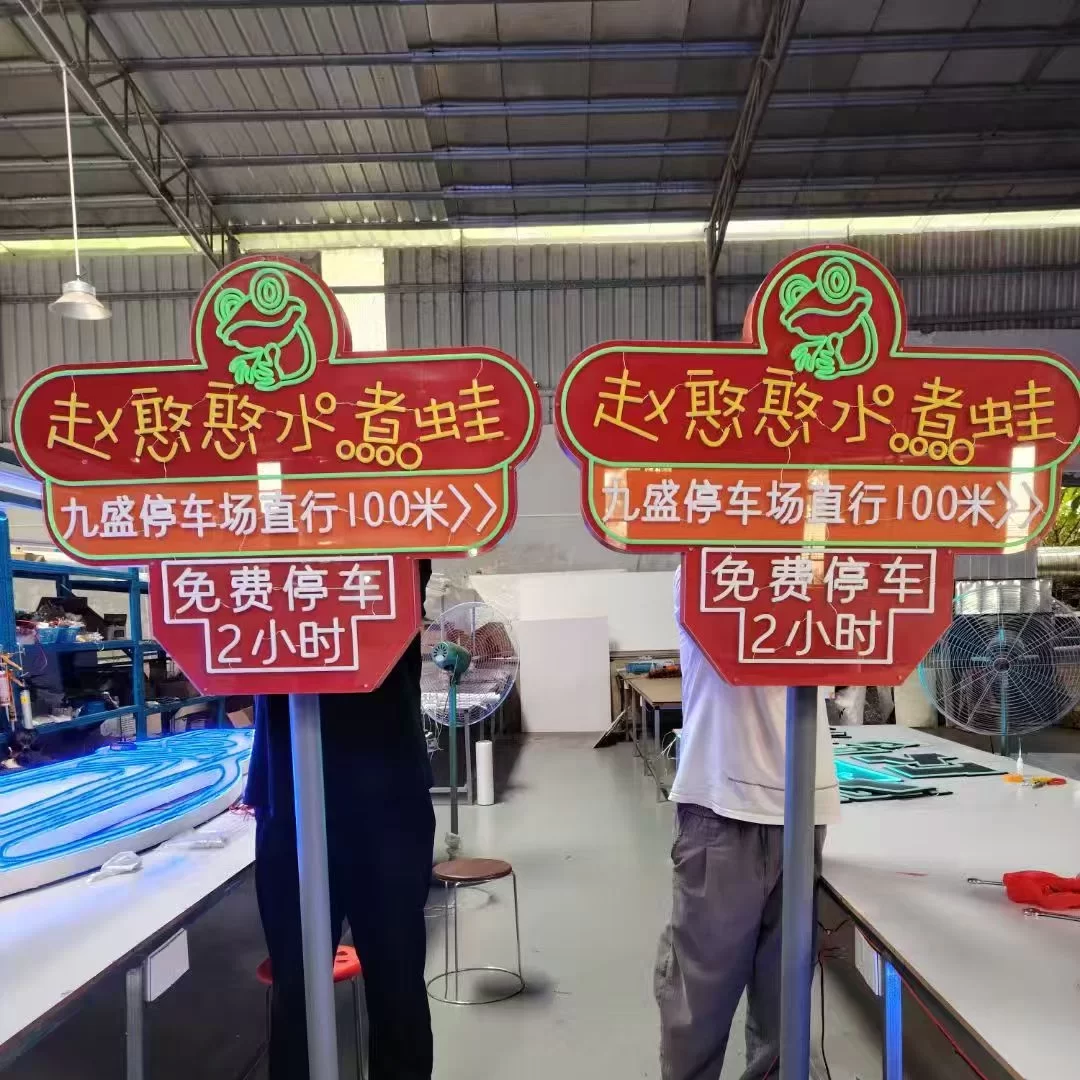
Standardized franchise lightbox signs are a common backbone for this kind of rollout: a rectangular illuminated box with a swappable face that carries the brand wordmark. Because the box design is reused across every location, manufacturing becomes efficient, replacement parts are identical, and a damaged sign at one store can be swapped without re-engineering anything. Dual-effect mini channel letters add a premium touch where the brand wants depth and dimensionality — front-lit at night with a subtle halo — while still following a repeatable spec.
The operations team’s job is to wave the rollout: pilot store, photo and install feedback, refinement, then national or regional rollout in batches. This catches installation issues early — a fascia that cannot accept the mounting rail, a mall landlord that requires a specific depth, a weather condition that the prototype did not anticipate — before those problems repeat across 50 stores.

Brand Consistency Across Materials and Suppliers
Brand consistency is harder than it looks when you start comparing sign suppliers. The same Pantone red on acrylic can look different from the same red on aluminum. A lightbox face printed on a backlit film will shift color after a year of UV exposure if the wrong ink was used. LED modules from different manufacturers produce subtly different white points, so a storefront made in two waves may have a visible seam where the older sign has yellowed.
The solution is to lock the manufacturing parameters once and reuse them. At Hongbo Signage, that means storing the approved artwork, recording the Pantone and color-matched LED temperature, and quoting repeat orders against the same bill of materials. For franchise clients, this is why a single OEM/ODM manufacturer across all sites usually wins on total cost: you avoid the hidden expense of comparing five local sign shops, and you avoid the even larger expense of rebranding locations that drifted.
Storefront Illumination: Lightbox, Channel Letters, and LED Neon
Illumination is where retail signage budgets usually get decided. The three common storefront illumination approaches each have a role:
- Lightbox signs are best for large rectangular areas, mall directories, and brands that need a clean flat face. They are economical at scale and easy to service.
- Channel letters — dimensional acrylic or metal letters mounted off the wall — give a premium, architectural look. Front-lit, backlit (halo), or combination options suit different budgets.
- LED neon is a flexible, low-energy alternative to traditional glass neon. Storefront LED neon signs are popular for boutique, food, and lifestyle brands that want a warm, trendy glow without the fragility and power draw of real glass neon. For a deeper comparison, our guide on LED neon storefront accents walks through the trade-offs.
For large-format retail spaces — supermarkets, big-box, and mall anchors — the sign program often scales up to include ceiling-hung department lightboxes and large backlit headers. Our guide on retail signage for larger formats covers supermarket-scale signage in more detail.
Durable, Easy-Clean Materials for Interior Retail
Inside a store, signs get touched, wiped, bumped by shopping carts, and splashed with coffee. The right interior materials are easy to clean and hold up to daily sanitizing:
- Acrylic — crystal-clear, available in many colors, easy to laser-cut into custom shapes.
- Aluminum composite — flat, rigid, printable, used for department signs and directory panels.
- Stainless steel — used at premium touchpoints like brand plaques and elevator lobbies.
- Powder-coated metal — durable finish for wall-mounted signage that sees heavy contact.
Hongbo Signage’s production line uses laser cutting for precision acrylic and metal shapes, bending and welding for structural frames, and powder coating for consistent exterior finishes. Illuminated signs go through an aging test before packing so that a dead LED module is caught at the factory rather than on the storefront at opening night.
MOQ, Lead Time, and Multi-Site Shipping
A single-store order typically has no meaningful MOQ concern. For a franchise rollout, the volume itself becomes the advantage: larger orders quote more aggressively per piece because the laser cutting, powder coating, and assembly lines run continuously.
Lead time is typically 10-25 working days after artwork approval. For a chain, we recommend scheduling production against the store opening calendar rather than ordering all signs at once. Wave planning keeps cash flow manageable and lets you correct the spec between waves.
Shipping to multiple stores adds logistics complexity. The most economical approach is usually to consolidate all signs for a region into one sea-freight shipment (LCL or FCL depending on volume), then distribute domestically once the container clears customs. Air freight is reserved for urgent replacements. Packaging matters: signs are nested in foam, corner-protected, and strapped to pallets, and each piece is labeled with the destination store code so that the receiving crew can stage signs by location. On arrival, a QC pass — count cartons, verify serial numbers against the packing list, inspect a sample face for scratches or color drift — catches most shipping issues before installation.
For a line-item breakdown of what drives retail sign cost, our guide on franchise sign budget planning walks through the main cost drivers.
What Buyers Should Prepare for a Sign Quote
Before requesting a retail sign quote, pull together the inputs that let a manufacturer price your real package rather than a guess:
- Your current brand guidelines: approved logo files, Pantone values, typeface, and acceptable color tolerances.
- Storefront dimensions for each location: facade width, available sign band, allowed depth, and mounting surface material (brick, aluminum panel, glass).
- A site-by-site rollout schedule tied to store opening dates, so production can be wave-planned against openings.
- Illumination preferences and any mall or landlord restrictions on sign type, brightness, and hours of operation.
- Interior layout notes: department locations, fitting room, register, and restroom wayfinding needs.
- A full component list (storefront, window graphics, interior department signs, seasonal overlays) so the package is bundled and priced together.
- Whether a local contractor will mount the finished signs, or whether installation guidance is needed.
Frequently Asked Questions
Q: How much does a retail storefront sign cost?
Costs vary widely by size, material, and whether the sign is illuminated. A small boutique lightbox or LED neon sign can be a few hundred to a few thousand dollars, while a large channel-letter storefront for a national brand often runs several thousand dollars per location. Because every project is custom, the most reliable way to budget is to send your artwork and facade dimensions to a manufacturer for a quote.
Q: What is the minimum order quantity for franchise signage?
For a single store, MOQ is low enough to support a boutique opening. For a franchise rollout, there is usually no hard MOQ penalty — larger orders simply quote more aggressively per piece because production runs are continuous. Speak with your manufacturer about wave planning if you are rolling out across many sites.
Q: How long does it take to manufacture custom retail signs?
Typical lead time is 10-25 working days after artwork approval, depending on quantity, material complexity, and illumination. Add transit time: sea freight typically takes several weeks door-to-door, while air freight is days but more expensive.
Q: Can one manufacturer produce signs for every franchise location?
Yes. The most reliable franchise rollouts use a single OEM/ODM manufacturer across all sites so that artwork, Pantone values, LED color temperature, and mounting hardware stay identical. Using multiple local sign shops usually produces drift between locations.
Q: How do I choose between a lightbox and channel letters for my storefront?
Lightboxes are economical and clean for large rectangular areas, mall directories, and rollouts. Channel letters give a more dimensional, premium look and work well on facades where depth is visible. LED neon is a flexible, low-energy option for boutique and lifestyle brands. Our guide on channel letters versus lightbox signs covers the trade-offs in detail.
Conclusion
Retail signage is a system, not a single purchase. The storefront sets the first impression; interior signs keep the customer moving; promotional signs carry seasonal messages; and compliance signs cover the legal baseline. For a single store, the goal is a beautiful, durable sign that fits the facade and the budget. For a franchise, the goal is brand consistency across every location — which means a written sign standard, a single trusted manufacturer, wave-planned production, and consolidated multi-site shipping. The payoff is a customer who recognizes your brand from a block away and a franchisee who never has to wonder whether their signs match the flagship.
Rolling out a consistent sign package across multiple retail locations?
Hongbo Signage provides OEM/ODM custom signage manufacturing from Guangzhou, China. Get a custom sign quote within 24 hours.