


The Critical Role of Signage in Gas Stations and C-Stores
Gas station signage is one of the most powerful tools for attracting customers, communicating fuel prices, and driving in-store sales in the highly competitive gas station and convenience store (c-store) industry. Unlike many other retail businesses, gas stations rely heavily on impulse purchases and drive-by traffic—customers often choose which gas station to stop at based on visibility, price perception, and the overall impression created by the station’s signage and appearance. A well-designed, high-visibility signage program can increase fuel volume by 5–15% and in-store sales by 10–20% by attracting more customers, communicating promotions effectively, and guiding customers through the purchase journey. Conversely, outdated, poorly maintained, or confusing signage can drive customers to competitors and significantly impact profitability.
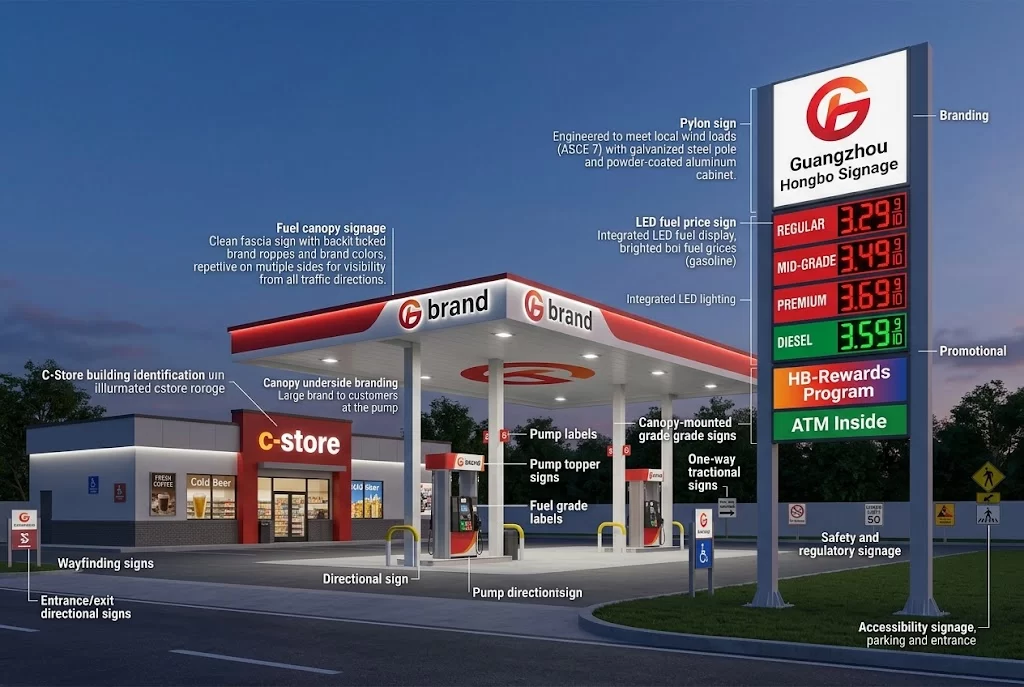
Gas station and c-store signage encompasses a wide range of sign types, each serving a specific purpose in the customer journey—from the roadside pylon sign that attracts passing motorists to the fuel price display that communicates pricing, the canopy signage that identifies the brand, the building-mounted signs that promote in-store products, and the directional and safety signs that guide customers safely through the station. Managing this complex signage ecosystem requires careful planning, consistent branding, compliance with regulatory requirements, and an understanding of how signage influences customer behavior at each touchpoint.
This guide provides a comprehensive overview of gas station and convenience store signage, covering all major sign types, design considerations, regulatory requirements, material selection, maintenance, and best practices for creating a high-visibility, conversion-focused signage program. Whether you are building a new gas station, rebranding an existing location, or upgrading signage for a multi-site c-store chain, this guide will help you understand what is needed and how to maximize the return on your signage investment.
Fuel Price Signs: The Most Important Sign at a Gas Station
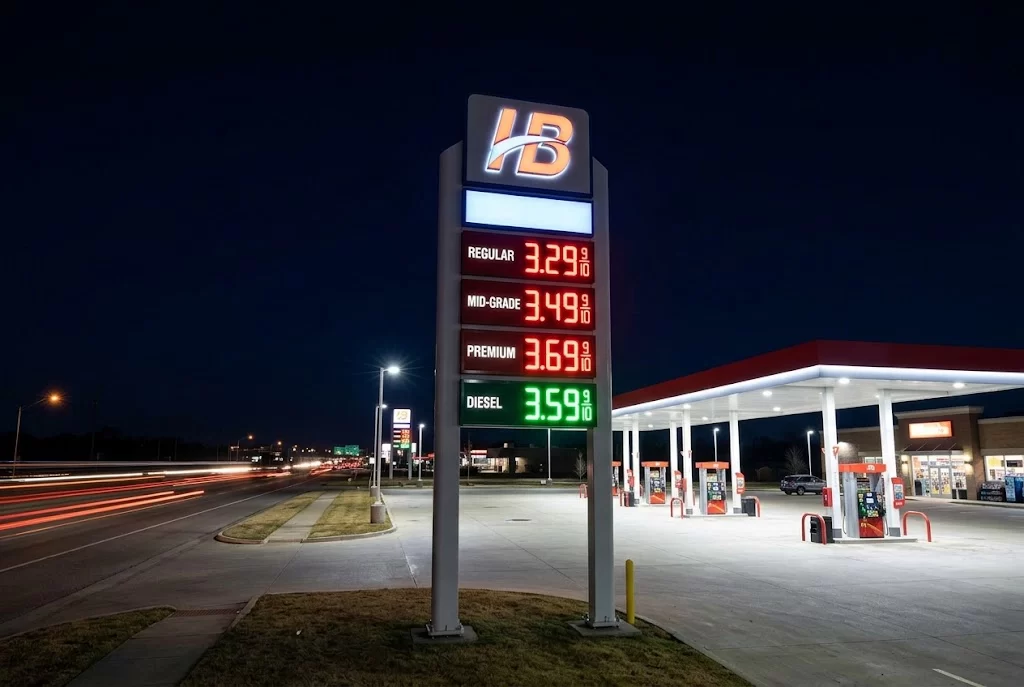
The fuel price sign is arguably the most important sign at a gas station, as fuel price is the primary factor driving customer choice for many motorists. A clear, visible, accurate fuel price sign can attract price-sensitive customers and increase fuel volume, while a hard-to-read, outdated, or inaccurate price sign can drive customers to competitors and damage the station’s reputation. Fuel price signs come in two primary types: manual (changeable) signs and electronic LED signs.
Manual Fuel Price Signs
Manual fuel price signs use physical number panels or tiles that are manually changed to update fuel prices. They are typically constructed from aluminum or acrylic, with individual number tiles that slide into tracks or attach magnetically. Manual price signs are the traditional, lower-cost option and are still commonly used at smaller, independent gas stations or in areas where electronic price signs are prohibited or not practical.
Advantages of manual price signs:
- Lower upfront cost than electronic LED signs
- No electrical power or wiring required (simpler installation)
- No risk of electronic failure or software issues
- Simple, reliable technology with minimal maintenance
- Not subject to regulations on electronic/digital signage (in areas where digital price signs are restricted)
Limitations of manual price signs:
- Requires manual labor to change prices (climbing a ladder, physically swapping number tiles), which is time-consuming and potentially dangerous for high-mounted signs
- Prone to human error (wrong numbers, missing tiles, misaligned numbers) which can cause pricing disputes or regulatory issues
- Numbers can be damaged, lost, or stolen, requiring replacement
- Limited visibility at night (requires separate illumination, such as a spotlight or backlighting)
- Cannot be updated remotely or integrated with pricing systems
- Less modern, premium appearance compared to LED price signs
Electronic LED Fuel Price Signs
Electronic LED fuel price signs use full-color LED displays to show fuel prices digitally, enabling prices to be updated remotely via a control panel, smartphone app, or integration with the station’s point-of-sale (POS) or fuel pricing system. LED price signs are the modern, increasingly popular choice for gas stations, particularly for larger chains and high-volume locations. They are available in various digit heights (typically 8″–24″ for roadside price signs) and colors (red, green, white, amber), with red being the most common for fuel prices due to its high visibility and association with fuel pricing.
Advantages of LED price signs:
- Remote price updates via control panel, smartphone, or POS integration—no manual labor or ladder climbing required, reducing labor costs and safety risks
- High visibility day and night, with bright, uniform LED digits that are easy to read from a distance
- Reduced risk of human error (prices are entered digitally and can be verified before display)
- Can display multiple fuel grades (regular, mid-grade, premium, diesel) simultaneously, with clear labels for each grade
- Can display additional information (promotions, loyalty program offers, car wash prices) in addition to fuel prices, maximizing the sign’s marketing value
- Modern, high-tech appearance that enhances the station’s brand image
- Can be integrated with fuel pricing software to automatically update prices based on market conditions, competitor pricing, or predefined pricing rules
- Long lifespan (50,000+ hours for LED digits) with low energy consumption
Limitations of LED price signs:
- Higher upfront cost than manual price signs (though the cost has declined significantly in recent years, making LED price signs accessible for most stations)
- Requires electrical power and wiring, and may require an electrical permit
- Subject to regulations on electronic/digital signage in some jurisdictions (brightness limits, size restrictions, permitting requirements)
- Potential for electronic failure (LED module failure, power supply failure, software/connectivity issues), though modern LED price signs are highly reliable
- Requires periodic maintenance (cleaning, software updates, occasional component replacement)
Fuel Price Sign Design Considerations
- Digit height and visibility: Choose digit height based on the distance from which the sign will be viewed. As a general rule, 1 inch of digit height is visible from approximately 30–50 feet. For roadside price signs viewed from 200–500 feet away, digit heights of 12″–20″ are typical. For signs closer to the road or in urban areas with slower traffic, 8″–12″ digits may be sufficient. Always verify local regulations, as some jurisdictions specify minimum digit height for fuel price signs.
- Number of fuel grades: Ensure the price sign can display all fuel grades offered at the station (typically regular, mid-grade, premium, and diesel, with some stations also offering E85, biodiesel, or electric vehicle charging). Each grade should be clearly labeled with the grade name and/or octane rating, with the price displayed adjacent to the label.
- Color selection: Red is the most common color for fuel price digits due to its high visibility and strong association with fuel pricing. Green is sometimes used for diesel prices (to differentiate from gasoline), and white or amber may be used for additional information. Ensure the digit color provides high contrast with the sign background (typically black or dark gray) for maximum readability.
- Brand integration: The fuel price sign should be integrated with the station’s brand identity, including brand colors, logo, and typography. Many gas station brands have specific design standards for fuel price signs, including digit color, background color, logo placement, and sign dimensions. For branded stations, always follow the brand’s signage standards and obtain brand approval before installing or modifying price signs.
- Mounting location: Fuel price signs are typically mounted on the station’s pylon sign (roadside), on the fuel canopy, or on a separate freestanding structure near the road. The sign should be positioned to be visible from both directions of traffic, with no obstructions (trees, buildings, other signs) blocking the view. For pylon-mounted price signs, ensure the pylon is structurally engineered to support the weight and wind load of the price sign.
- Regulatory compliance: Fuel price signs are subject to specific regulations in many jurisdictions, including requirements for digit height, sign size, location, illumination, and accuracy. Some jurisdictions require fuel prices to be displayed in a specific format (e.g., including 9/10 of a cent), and may prohibit additional advertising or information on fuel price signs. Always check local weights and measures regulations, sign codes, and (for branded stations) brand standards before installing a fuel price sign.
Pylon and Monument Signs: Roadside Visibility and Brand Identity
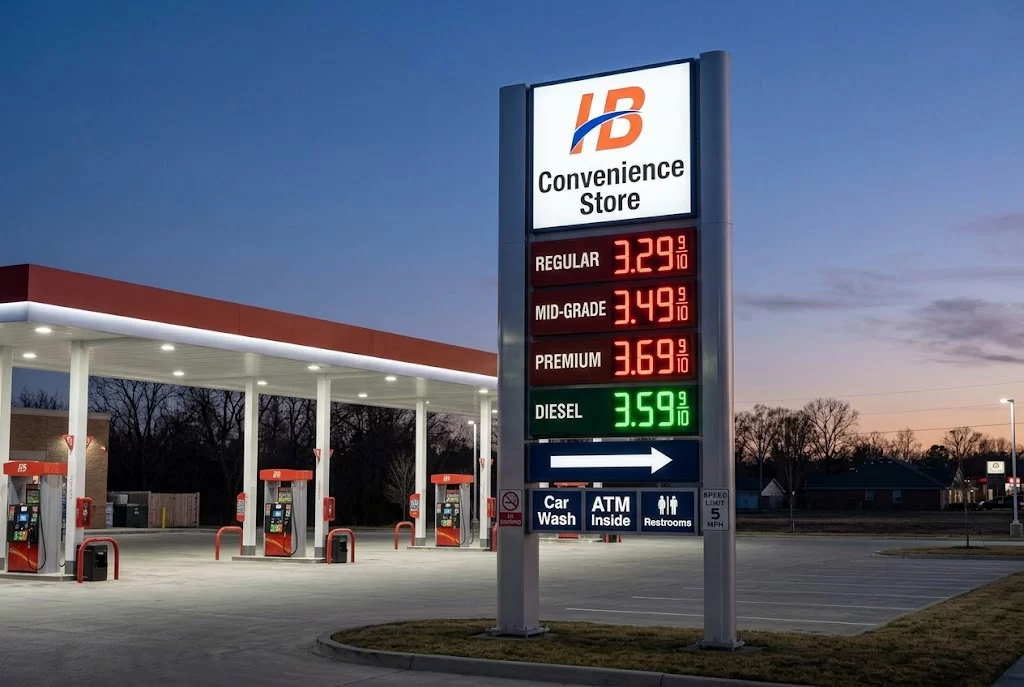
The pylon sign (also called a freestanding sign, pole sign, or roadside sign) is the primary brand identification and visibility element for a gas station, typically positioned near the road to attract passing motorists and communicate the station’s brand, fuel prices, and promotions. Pylon signs for gas stations are typically tall (20–60 feet high) to maximize visibility from a distance, and may include the brand logo, fuel price display, promotional panels, and (for multi-tenant sites) tenant panels for the c-store, car wash, or fast-food restaurant.
Pylon Sign Types for Gas Stations
- Single-pole pylon signs: The most common and economical type, with a sign cabinet mounted on a single metal pole. Single-pole pylons are typically 20–40 feet high and are suitable for most standard gas station applications.
- Double-pole / twin-mast pylon signs: With a sign cabinet mounted between two parallel poles, creating a more substantial, premium appearance. Double-pole pylons are typically taller (30–60 feet) and are used for high-visibility locations, large stations, or premium brand identities.
- Monument signs: Low-profile, ground-mounted signs (typically 4–10 feet high) that provide a more understated, integrated appearance. Monument signs are sometimes used at gas stations in areas with strict height limits (e.g., near airports, in historic districts, or in communities with sign height restrictions), or as a secondary sign at the station entrance.
- Multi-tenant pylon signs: For gas stations with additional tenants (c-store, fast-food restaurant, car wash, bank ATM), multi-tenant pylon signs include separate panels for each tenant, with the gas station brand typically at the top and tenant panels below. Multi-tenant pylons require careful design to ensure all tenants are visible and the sign remains balanced and readable.
Pylon Sign Design Considerations
- Height and visibility: Pylon sign height should be determined based on the distance from the road, traffic speed, surrounding obstructions (trees, buildings, other signs), and local height regulations. Higher signs provide greater visibility from a distance, particularly in high-speed highway or arterial road locations, but may be restricted by local sign codes or brand standards. Always verify local height limits and obtain the necessary permits before installing a pylon sign. Our guide to pylon signs and pole signs provides detailed information on pylon sign design, construction, and regulations.
- Brand logo and identity: The pylon sign should prominently display the gas station brand logo, with colors, typography, and proportions matching the brand’s identity standards. The logo should be visible from a distance and should not be overshadowed by other elements on the sign (fuel prices, promotions, tenant panels). For branded stations, the brand typically provides specific design standards for pylon signs, including logo size, placement, and illumination.
- Fuel price display integration: Most gas station pylon signs include an integrated fuel price display (manual or LED), positioned below the brand logo and above any promotional or tenant panels. The price display should be clearly visible from the road and should be integrated into the overall sign design, not added as an afterthought. Ensure the pylon structure is engineered to support the weight and wind load of the price display, and that electrical wiring for LED price signs is properly routed and sealed.
- Illumination: Pylon signs for gas stations are typically illuminated for 24/7 visibility, using either internal illumination (LED modules inside the sign cabinet illuminating a translucent face) or external illumination (spotlights or floodlights directed at the sign face). LED illumination is the most common and energy-efficient choice, with options for front-lit, backlit, or edge-lit brand logos. Ensure the sign is adequately illuminated for nighttime visibility, but avoid excessive brightness or glare that may disturb nearby residents or violate local lighting regulations.
- Promotional and tenant panels: Many gas station pylon signs include changeable promotional panels (for displaying current promotions, loyalty program offers, or c-store specials) and/or tenant panels (for additional tenants). Promotional panels may use vinyl graphics (applied to the sign face), slide-in panels, or digital LED displays for dynamic content. Ensure promotional and tenant panels are positioned below the brand logo and fuel price display (in order of priority) and that they do not detract from the primary brand and price information.
- Material and durability: Pylon signs are exposed to harsh outdoor conditions (wind, rain, snow, UV radiation, temperature extremes) and must be constructed from durable, weather-resistant materials. The sign cabinet is typically fabricated from aluminum (with powder coating) or stainless steel, with acrylic or polycarbonate faces. The pole is typically steel (galvanized or powder-coated) or aluminum, with a concrete foundation. Ensure all materials and finishes are suitable for the local climate (e.g., 316 stainless steel or marine-grade powder coating for coastal areas) and that the sign is properly sealed to prevent water intrusion.
- Structural engineering and wind load: Pylon signs are tall, freestanding structures that must be engineered to withstand local wind loads (per ASCE 7 or local building code), including wind gusts, seismic activity (in earthquake-prone areas), and ice/snow loads (in cold climates). A licensed structural engineer should design the pylon foundation and structure, and the sign should be installed by a qualified professional with experience in pylon sign installation. Always obtain the necessary building permits and inspections for pylon sign installation.
Fuel Canopy Signage: Branding and Protection at the Pump
The fuel canopy (also called the gas canopy, forecourt canopy, or pump canopy) is the overhead structure that covers the fuel pumps, providing protection from sun and rain for customers and creating a large, visible branding surface. Canopy signage is a critical element of the gas station’s brand identity, typically including the brand logo on the canopy fascia (the vertical edge of the canopy), the brand name or logo on the canopy underside (visible to customers at the pump), and fuel grade labels on each pump island.
Canopy Fascia Signs
The canopy fascia (the vertical, visible edge of the canopy structure) is one of the largest branding surfaces at a gas station, visible from the road and from the forecourt. Canopy fascia signs typically display the gas station brand logo and/or brand name, using illuminated channel letters, push-through letters, or a backlit sign panel. Key design considerations include:
- Sign type: Canopy fascia signs are typically either illuminated channel letters (individual 3D letters mounted to the fascia), push-through letters (acrylic letters pushing through a metal sign panel mounted to the fascia), or a backlit/edge-lit sign panel (a translucent panel with the brand logo, illuminated from behind). Our guide to push-through letters provides detailed information on this popular option for canopy signage.
- Illumination: Canopy fascia signs are almost always illuminated for nighttime visibility, using LED modules. Front-lit letters (illuminated from the front) provide high visibility, while backlit/halo-lit letters create a more subtle, premium glow effect. Ensure the illumination is uniform and that the sign is visible from both directions of traffic and from the forecourt.
- Size and placement: The canopy fascia sign should be sized proportionally to the canopy dimensions, with the brand logo/name centered or positioned to be visible from the primary traffic direction. For large canopies (covering 6+ pumps), the brand logo may be repeated on multiple sides of the canopy for visibility from all approaches.
- Brand standards: For branded gas stations, the canopy fascia sign must comply with the brand’s signage standards, including logo size, placement, color, illumination, and font. Always obtain brand approval before installing or modifying canopy signage.
- Installation and weather sealing: Canopy fascia signs are mounted to the canopy structure, which is typically steel or aluminum. Ensure the sign is securely mounted with corrosion-resistant fasteners, and that all electrical wiring is properly routed through the canopy structure and sealed to prevent water intrusion. Canopy signs are exposed to wind and weather, and proper installation is critical to prevent damage or safety hazards.
Canopy Underside Branding
The underside of the fuel canopy (the ceiling visible to customers at the pump) provides an additional branding surface that is directly in the customer’s line of sight while they are fueling. Canopy underside branding may include:
- Brand logo or name: Large, printed or illuminated brand logos on the canopy underside, creating an immersive brand experience for customers at the pump.
- Promotional graphics: Printed graphics promoting c-store products, loyalty programs, car washes, or other services, leveraging the captive audience at the pump to drive additional sales.
- Canopy lighting: Integrated LED lighting in the canopy underside provides illumination for the forecourt and pumps, enhancing safety and security while also contributing to the brand atmosphere. Color-changing LED lighting (for brands that use specific colors) can create a distinctive, recognizable nighttime appearance.
Canopy underside branding is typically applied using vinyl graphics, printed fabric panels, or painted murals, depending on the canopy construction and brand requirements. For new construction, the canopy underside may be designed with integrated branding elements (recessed logos, backlit panels, integrated lighting) for a more premium, seamless appearance.
Pump Island and Fuel Grade Signage
Each fuel pump island requires clear signage identifying the fuel grades available at that pump, the octane ratings, and (for diesel) the diesel type. Pump island signage typically includes:
- Fuel grade labels on pumps: Each fuel dispenser has labels identifying the fuel grade (regular, mid-grade, premium, diesel) and octane rating, typically displayed on the pump’s top panel and on the nozzle holder. These labels are usually provided by the fuel dispenser manufacturer or the gas station brand, and must comply with weights and measures regulations.
- Pump topper signs: Small signs mounted on top of each fuel dispenser, displaying the fuel grade and/or price for that pump. Pump topper signs help customers identify the correct pump from a distance and can reduce confusion at the pump. They may be manual (changeable labels) or electronic (small LED displays showing real-time prices).
- Canopy-mounted grade signs: Signs mounted to the canopy underside or fascia above each pump island, identifying the fuel grades available at that island. These signs are particularly useful at large stations with multiple islands, helping customers navigate to the correct pump for their desired fuel grade.
- Alternative fuel signage: For stations offering alternative fuels (E85, biodiesel, compressed natural gas, electric vehicle charging), specific signage is required to identify the alternative fuel type, compatibility requirements, and pricing. These signs must comply with federal and state regulations for alternative fuel labeling.
Building-Mounted and C-Store Signage
In addition to fuel-related signage, gas stations and convenience stores require building-mounted signage to identify the c-store, promote products and services, and create a welcoming entrance. Building-mounted signage for c-stores typically includes:
C-Store Building Identification
- Store name/logo sign: A building-mounted sign identifying the c-store name and/or brand logo, typically mounted above the entrance or on the building facade facing the road. For branded c-stores (e.g., 7-Eleven, Circle K, Shell Select), the sign must comply with brand standards. For independent c-stores, the sign should reflect the store’s brand identity and be clearly visible from the forecourt and road.
- Entrance signage: Clear signage identifying the store entrance, including “Enter” or “Entrance” signs, door decals, and (for automatic doors) operating instructions. Entrance signage should be well-lit and visible from the parking area and pumps, guiding customers into the store.
- Hours of operation: A sign displaying the store’s hours of operation, typically mounted near the entrance or on the entrance door. For 24-hour stores, a “24 Hours” or “Open 24/7” sign communicates availability and can attract customers at all hours.
Promotional and Product Signage
- Window graphics and decals: Vinyl graphics on the store windows promoting products, services, or promotions (e.g., “Fresh Coffee,” “ATM Inside,” “Loyalty Program,” “Cold Beer,” “Hot Food”). Window graphics are a cost-effective way to communicate with customers at the entrance and can be easily updated as promotions change. Ensure window graphics do not obstruct too much of the window (many jurisdictions limit window coverage to 25–30% of the window area) and that they comply with brand standards.
- Product category signage: Interior signage identifying product categories (coffee, beverages, snacks, groceries, tobacco, alcohol, lottery, ATM, restrooms) to help customers navigate the store and find products quickly. Well-designed interior category signage can improve the customer experience and increase sales by making products easier to find.
- Promotional displays and signage: Point-of-purchase (POP) signage and displays promoting specific products, limited-time offers, or loyalty program promotions. These signs are typically provided by product vendors or the c-store brand, and should be placed in high-traffic areas (near the entrance, at the checkout counter, at end caps) to maximize visibility and impulse purchases.
- Service signage: Signage promoting additional services offered at the station, such as car wash, ATM, propane exchange, lottery, money orders, bill payment, or electric vehicle charging. Service signage should be placed both outside (on the pylon or building) and inside (near the relevant service area) to inform customers and drive usage.
For c-stores with food service (coffee, hot food, sandwiches), a digital menu board is one of the highest-ROI additions to the interior signage package—it keeps prices, product images, and daily specials current without reprinting signage. See our guide to menu board signs and LED menu displays for sizing, placement, and technology options in high-traffic convenience retail.
Interior Wayfinding and Informational Signage
- Restroom signs: ADA-compliant restroom signs identifying men’s, women’s, and unisex/family restrooms, with tactile characters and Grade 2 Braille as required by the ADA. Our guide to ADA restroom signs and Braille signs provides detailed specifications.
- Exit and emergency signage: Illuminated exit signs and emergency lighting as required by NFPA 101 and local building codes, ensuring safe egress in case of emergency. Our guide to exit signs and emergency signage provides detailed requirements.
- Safety and regulatory signage: OSHA-compliant safety signage (no smoking, hazard identification, emergency contact information), age-restricted product signage (tobacco, alcohol, lottery), and other regulatory signage required by federal, state, and local regulations.
- Customer service signage: Signage indicating customer service areas, checkout counters, and self-service kiosks, helping customers navigate the store and complete purchases efficiently.
Directional, Safety, and Traffic Flow Signage
Gas stations are high-traffic areas with a mix of vehicles (cars, trucks, motorcycles) and pedestrians (customers walking between pumps and the store), and effective directional and safety signage is essential for ensuring smooth traffic flow, preventing accidents, and creating a safe, welcoming environment.
Traffic Flow and Directional Signage
- Entrance/exit signs: Clear signage identifying the station entrance and exit, with directional arrows guiding vehicles into and out of the station. Entrance/exit signs should be visible from the road and should be positioned to prevent wrong-way entry or confusion.
- One-way traffic signs: For stations with one-way traffic flow (common in modern c-store designs to improve safety and efficiency), one-way signs and directional arrows guide vehicles through the station in the correct direction, preventing head-on collisions and congestion.
- Pump directional signs: Signs guiding vehicles to available pumps, particularly during peak hours or at large stations with multiple pump islands. These may include “Pumps 1–4 →” signs or digital displays showing available pumps.
- Parking signage: Signs identifying parking areas for c-store customers, accessible parking spaces (with the International Symbol of Accessibility), and reserved parking (for employees, delivery vehicles, or specific customer types).
- Additional service directional signs: Signs guiding customers to additional services such as car wash, propane exchange, air/water station, vacuum, electric vehicle charging, or ATM. These signs should be placed at decision points (entrance, pump area) and near the service location.
Safety and Regulatory Signage
- No smoking / open flame signs: Required at all gas stations due to the fire hazard posed by gasoline vapors. These signs should be prominently displayed at the station entrance, near each pump, and on the fuel canopy. Many jurisdictions require specific wording and placement for these signs.
- Turn off engine / no cell phone signs: Signs reminding customers to turn off their engines while fueling and (at some stations) to refrain from using cell phones near the pumps (though the fire risk from cell phones is debated, many stations still post these signs as a precaution).
- Speed limit signs: Posted speed limit signs (typically 5–10 mph) within the station, reducing vehicle speed and improving safety for pedestrians and other vehicles.
- Pedestrian crossing signs: Signs marking pedestrian crosswalks between the pump area and the store entrance, alerting drivers to watch for pedestrians.
- Hazard signs: Signs identifying specific hazards such as underground storage tanks, fuel delivery areas, high-voltage equipment, or wet floors. These signs should comply with OSHA and local fire code requirements.
- Emergency contact signage: Signs displaying emergency contact information (fire department, police, poison control, station manager) and emergency procedures (spill response, fire response, evacuation routes), typically posted near the pumps and in the store.
Accessibility Signage
- Accessible fuel pump signs: Signs identifying accessible fuel pumps (equipped with extended reach nozzles, accessible height controls, and call buttons for assistance) as required by the ADA. Accessible pump signs should include the International Symbol of Accessibility and should be visible from the accessible parking space and pump approach.
- Accessible parking signs: ADA-compliant accessible parking signs, mounted at the required height and location, identifying accessible parking spaces and any restrictions (e.g., van-accessible).
- Accessible entrance signs: Signs identifying the accessible entrance to the c-store, with the International Symbol of Accessibility and directional arrows if the accessible entrance is different from the main entrance.
- ADA-compliant interior signage: All permanent room and space identification signs (restrooms, storage, mechanical rooms) must be ADA-compliant with tactile characters and Grade 2 Braille, as discussed earlier.
Designing a Cohesive Gas Station Signage Program
A successful gas station and c-store signage program is cohesive, consistent, and aligned with the brand identity while addressing the unique functional and regulatory requirements of the fuel retail environment. Follow these best practices when designing your signage program:
1. Develop a Signage Master Plan
Before purchasing or installing any signs, develop a comprehensive signage master plan that identifies all sign types, locations, and specifications needed for the station. The master plan should include:
- Roadside pylon/monument sign (with fuel price display and brand logo)
- Fuel canopy signage (fascia signs, underside branding, pump island signs)
- Building-mounted c-store signage (store identification, entrance signs, hours)
- Promotional signage (window graphics, interior product signs, POP displays)
- Directional and traffic flow signage (entrance/exit, one-way, pump directional, parking)
- Safety and regulatory signage (no smoking, speed limit, hazard, emergency contact)
- Accessibility signage (accessible pumps, parking, entrance, ADA interior signs)
- Interior wayfinding and informational signage (restrooms, exits, product categories)
The master plan should also specify the design system (materials, colors, typography, illumination, mounting methods) to ensure consistency across all signs, and should identify which signs are permanent vs. temporary/changeable (promotional graphics, fuel prices, POP displays).
2. Prioritize Visibility and Readability
The primary goal of gas station signage is to be visible and readable to passing motorists and customers, so prioritize visibility and readability in all design decisions:
- High contrast: Use high-contrast color combinations for all text and graphics (e.g., white/yellow text on dark background, red digits on black background) to maximize readability in all lighting conditions.
- Appropriate size: Size all text and graphics appropriately for the intended viewing distance. Roadside signs (pylon, fuel price) require larger text than signs viewed up close (pump labels, interior product signs). Use the 1 inch = 30–50 feet visibility rule as a starting point, and adjust based on traffic speed and environmental conditions.
- Simple, legible typography: Use bold, sans-serif fonts (e.g., Helvetica Bold, Arial Bold, Gotham Bold) for all signage, avoiding decorative or script fonts that are difficult to read from a distance or at high speed. Ensure consistent typography across all signs for brand cohesion.
- Minimal clutter: Avoid overcrowding signs with too much text or too many graphics. Each sign should have a clear, primary message (brand logo, fuel price, promotion) with secondary information kept to a minimum. Prioritize information based on importance (brand > fuel price > promotion > tenant).
- Illumination: Ensure all exterior signs are adequately illuminated for nighttime visibility, with uniform illumination and no dark spots or hot spots. Use LED illumination for energy efficiency and long lifespan, and ensure illumination levels comply with local lighting regulations (no excessive glare or light pollution).
3. Maintain Brand Consistency
For branded gas stations, consistent branding across all signage is essential for building brand recognition and customer trust. Ensure all signs comply with the brand’s signage standards, including:
- Brand logo usage (correct version, proportions, clear space, color)
- Brand colors (Pantone-matched for print, specific LED colors for illumination)
- Brand typography (approved fonts, weights, sizes)
- Sign dimensions and proportions (standardized pylon, canopy, and building sign dimensions)
- Illumination standards (specific LED color temperature, brightness, illumination type)
- Material and finish standards (specific aluminum finishes, acrylic colors, powder coat colors)
For independent or unbranded gas stations, develop a consistent brand identity and apply it across all signage, creating a professional, cohesive appearance that builds customer trust and loyalty. Even independent stations benefit from a well-designed, consistent signage program that creates a strong brand impression.
4. Comply with All Regulatory Requirements
Gas station signage is subject to a wide range of federal, state, and local regulations, and non-compliance can result in fines, mandatory sign removal, or even station closure. Key regulatory areas include:
- Sign codes and zoning: Local sign codes regulate sign size, height, setback, illumination, and number of signs. Pylon signs, in particular, are often subject to strict height and size limits. Always obtain the necessary sign permits before installing or modifying signage. Our guide to outdoor sign permits and zoning provides detailed information on the permit process.
- Weights and measures regulations: Fuel price signs and pump labels must comply with state and local weights and measures regulations, including requirements for price accuracy, digit height, fuel grade labeling, and octane rating display. Regularly verify that displayed prices match the prices charged at the pump, as pricing discrepancies can result in significant fines.
- Fire code and safety regulations: Local fire codes regulate signage near fuel dispensers and storage tanks, including requirements for no-smoking signs, hazard signage, emergency contact information, and restrictions on signage that may obstruct fire access or emergency equipment.
- ADA accessibility requirements: All permanent interior signage (restrooms, room identification) must be ADA-compliant with tactile characters and Grade 2 Braille. Accessible fuel pumps, parking spaces, and entrances must be identified with appropriate accessibility signage. Our ADA signage guide provides detailed specifications.
- NFPA 101 and building codes: Exit signs, emergency lighting, and egress signage must comply with NFPA 101 and local building codes. Our exit signs guide provides detailed requirements.
- Age-restricted product signage: Signage for tobacco, alcohol, lottery, and other age-restricted products must comply with federal and state regulations, including requirements for age verification signage, health warnings, and placement restrictions (e.g., tobacco products cannot be visible from outside the store in some jurisdictions).
Always consult with local building departments, fire marshals, weights and measures officials, and (for branded stations) brand compliance teams to ensure all signage meets applicable requirements before installation.
5. Plan for Maintenance and Updates
Gas station signage requires regular maintenance and frequent updates (fuel prices, promotions, seasonal graphics), so design the signage program with maintainability and updateability in mind:
- Easy-access fuel price signs: Choose fuel price signs that allow easy, safe price updates (LED signs with remote updates are ideal; manual signs should be positioned at a height that allows safe access without a tall ladder). Ensure replacement number tiles (for manual signs) are readily available.
- Changeable promotional panels: Use changeable promotional panels (slide-in panels, vinyl graphics, digital displays) for pylon and building signs, allowing promotions to be updated easily without replacing the entire sign. Ensure promotional panels are positioned for easy access and that replacement graphics are readily available.
- Durable, weather-resistant materials: Use commercial-grade, weather-resistant materials (aluminum, stainless steel, acrylic, UV-stabilized vinyl) for all exterior signs, ensuring they can withstand harsh outdoor conditions and frequent cleaning. Our guide to LED sign maintenance provides detailed cleaning and maintenance recommendations.
- Easy access for maintenance: Ensure all signs (particularly illuminated signs and LED price displays) have easy access for maintenance and repair, with removable panels or access doors. Position electrical components (power supplies, controllers) in accessible locations, and ensure wiring is properly labeled for troubleshooting.
- Regular maintenance schedule: Establish a regular maintenance schedule for all signage, including daily visual checks (fuel price accuracy, sign illumination), weekly cleaning (pumps, windows, canopy), monthly inspections (sign condition, illumination, mounting), and annual professional service (electrical testing, structural inspection, LED replacement as needed).
Hongbo Sign Gas Station and C-Store Signage Solutions
At Hongbo Sign, we design and manufacture comprehensive signage solutions for gas stations and convenience stores, including independent stations and branded chains. With over a decade of experience in commercial signage manufacturing and a deep understanding of the unique requirements of the fuel retail environment, we deliver high-quality, durable, high-visibility signage that attracts customers, communicates fuel prices clearly, and drives in-store sales.
- Comprehensive product range: We manufacture every type of gas station and c-store signage, including pylon and monument signs (with integrated fuel price displays), LED and manual fuel price signs, canopy fascia signs (channel letters, push-through letters, backlit panels), canopy underside branding, pump island and fuel grade signs, building-mounted c-store signs, window graphics, interior product and wayfinding signage, directional and traffic flow signs, safety and regulatory signage, and ADA-compliant accessibility signage.
- LED fuel price sign expertise: We specialize in high-quality LED fuel price signs with bright, uniform LED digits (red, green, white, amber), remote price update capabilities (control panel, smartphone app, or POS integration), multiple fuel grade displays, and optional promotional/information panels. Our LED price signs are energy-efficient, long-lasting (50,000+ hour LED lifespan), and available in a range of digit heights (8″–24″) to suit different viewing distances and regulatory requirements.
- Pylon sign engineering and manufacturing: We design and manufacture custom pylon and monument signs for gas stations, including single-pole, double-pole, and multi-tenant configurations. Our pylon signs are engineered to meet local wind load requirements (ASCE 7) and are constructed from durable, weather-resistant materials (galvanized steel poles, aluminum cabinets with powder coating, acrylic faces). We provide structural engineering calculations and all documentation needed for building permit applications.
- Canopy signage specialization: We have extensive experience designing and manufacturing canopy fascia signs for gas stations, including illuminated channel letters, push-through letters, and backlit/edge-lit sign panels. Our canopy signs are engineered for secure mounting to canopy structures, with proper weather sealing and electrical routing. We also offer canopy underside branding (vinyl graphics, printed panels, integrated LED lighting) and pump island signage.
- Brand compliance and customization: For branded gas stations, we work closely with brand teams to ensure all signage complies with brand standards, including logo usage, colors, typography, dimensions, and illumination. We can match brand-specific Pantone colors, LED colors, and material finishes. For independent stations, we offer custom design services to create a unique, professional brand identity and cohesive signage program.
- Regulatory compliance support: We provide all documentation and certifications needed for regulatory compliance, including UL listing for illuminated signs and LED price displays, structural engineering calculations for pylon signs, ADA-compliant tactile/Braille signage, and sign drawings/specifications for permit applications. We stay current with federal, state, and local regulations affecting gas station signage and can advise on compliance requirements.
- Multi-site rollout capability: Whether you are building a single gas station or rolling out signage across a 100+ site c-store chain, we have the production capacity and project management systems to deliver consistent, high-quality signage across all locations. We offer centralized project management, coordinated production and shipping schedules, brand consistency controls, and bulk pricing for large orders.
- Durable, low-maintenance design: All our gas station signage is designed for durability and low maintenance in harsh outdoor environments, using commercial-grade aluminum, stainless steel, UV-stabilized acrylic, and high-quality LED components. We design signs with easy access for maintenance and repair, with modular, replaceable components (LED modules, power supplies, controllers) to minimize downtime and repair costs.
- Installation support: We provide comprehensive installation instructions, mounting templates, wiring diagrams, and technical support for your local installation team. For complex installations (pylon signs, canopy signage, LED price displays), we can provide remote technical support or coordinate with your installer to ensure proper installation and electrical connection.
- Competitive factory-direct pricing: As a direct manufacturer, we offer competitive factory-direct pricing with no middleman markup. We provide transparent, itemized quotations with no hidden fees, and we can work with you to find cost-effective solutions that meet your budget without compromising quality, visibility, or regulatory compliance.
We understand that gas station signage is a critical investment in your station’s visibility, customer attraction, and profitability, and we are committed to delivering signage that performs reliably, looks great, and drives results. From initial signage master planning and design to fabrication, quality control, shipping, and after-sales support, we are with you every step of the way.
Ready to upgrade your gas station or c-store signage? Contact us today for a free consultation and factory-direct quote. Our team will work with you to design a high-visibility, conversion-focused signage program that attracts customers, communicates fuel prices clearly, and drives in-store sales.
Frequently Asked Questions
Q: What signage does a gas station need?
A: A typical gas station signage package includes a pylon sign with fuel price displays, canopy identification and branding, pump toppers, entrance/exit directional signs, convenience store identification, promotional displays, restroom and wayfinding signs, and regulatory signage. The specific package depends on station size, brand requirements, and local regulations.
Q: How do electronic fuel price displays work?
A: Electronic fuel price displays use LED modules to show current fuel prices that can be updated remotely through a control system or software. Modern systems support real-time price changes, scheduled updates, and integration with point-of-sale or pricing management software. LED price displays offer high visibility day and night and eliminate the need for manual price changes with physical number tiles.
Q: Can gas station signage withstand harsh outdoor conditions?
A: Yes, gas station signage is designed for outdoor exposure with weather-resistant materials, UV-stabilized acrylic, powder-coated metal, and sealed electrical enclosures. Pylon signs and canopy signs are engineered to withstand wind loads, rain, snow, and temperature extremes. Always confirm the environmental rating, wind-load certification, and warranty coverage for your specific installation location.