


Channel letters come in two dominant lighting styles: front-lit (also called push-through) and backlit (also called halo-lit or reverse-lit). Both are illuminated three-dimensional letters mounted on a wall, but they produce completely different visual effects at night, suit different facade materials, and carry different price points. If you are specifying a storefront sign, choosing between front lit vs backlit channel letters is one of the most consequential design decisions you will make.
This guide explains the construction differences, the glow aesthetic, day and night readability, installation complexity, cost premium, and which style suits modern versus traditional building facades.
How Front-Lit Channel Letters Are Built
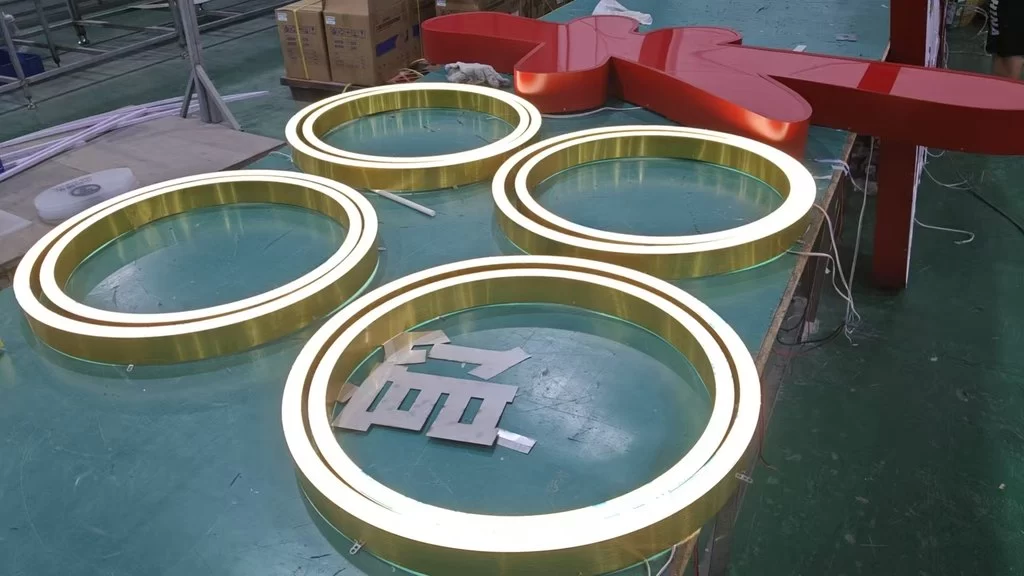
Front-lit channel letters are a sealed aluminum or stainless steel can. The front face is cut from translucent acrylic, usually color-matched to your brand with Pantone or RAL values. LED modules are mounted inside the can, shining forward through the acrylic face. The returns (the sides) are painted or brushed to match, and the whole letter mounts on concealed standoffs or a raceway.
The daylight appearance is a solid-colored dimensional letter. At night, the entire face glows. This is the workhorse style for fast food, gas stations, auto dealerships, and almost any brand that needs to be read from a moving car at 60 km/h.
How Backlit (Halo) Channel Letters Are Built
Backlit channel letters have an opaque face, typically brushed or mirror stainless steel, and an open back. LED modules face backward toward the wall. The letters are mounted 3-5 cm off the wall on stainless standoffs, so the light spills around the perimeter of each letter and paints a soft halo onto the building surface behind.
Daytime, backlit letters read as premium stainless steel metal lettering with no obvious lighting. At night, the wall blooms with a warm, diffuse outline. This is the signature look of boutique hotels, cocktail bars, luxury auto showrooms, and modern architecture.
Glow Aesthetic: Two Different Brand Languages
Front-lit glow is bold, commercial, and highly legible. It says “we are open, drive in.” It is the right language for quick-service restaurants, gas stations, pharmacies, and any brand whose customers are scanning the street from a vehicle.
Backlit halo glow is restrained, architectural, and premium. It says “this is a considered space.” It is the right language for hospitality, real estate lobbies, jewelry, and tech offices. The halo effect also photographs beautifully, which matters for brands whose storefront appears on social media.

Day vs Night Readability
Daytime
In daylight, front-lit letters show a colored acrylic face. If the acrylic is not UV-stabilized, cheap versions can yellow in 2-3 years. Premium cast acrylic holds color for a decade or more.
Backlit letters show a stainless steel face all day, so there is no daytime color fade problem. The daytime look is essentially the same as a non-lit metal letter set, which many architects prefer.
Nighttime
At night, front-lit letters win on raw legibility. The face is bright, and the letter shape is unambiguous. Backlit letters are beautiful but are less legible at long distance because you read the outline rather than the fill. They are ideal for pedestrian-scale contexts (3-15 meters viewing distance) rather than highway distances.
Facade Material Matters More Than People Think
The halo effect only looks good on certain wall surfaces.
- Painted drywall, smooth concrete, matte stone: halos look beautiful, soft, and even.
- Brick, textured stone, wood slats: halos become interesting and architectural, with texture catching the light.
- Dark glossy surfaces, dark glass, mirrored panels: halos almost disappear. The contrast drops and the premium look is wasted.
Front-lit letters work equally well on any surface, because the brightness comes from the letter itself rather than the wall behind it.
Installation Complexity
Both styles require wiring and a local electrician, but backlit letters add a few steps. Each letter must be spaced consistently off the wall on standoffs to cast an even halo; uneven spacing produces uneven light rings. The wiring must be hidden cleanly, and the standoff spacing must match the wall’s material. Front-lit letters are more forgiving because the viewer reads the face, not the gap.
If your wall is dark glass or a dark panel, front-lit is usually the safer, more legible choice.
LED Color Temperature: An Overlooked Decision
Both front-lit and backlit letters let you choose the LED color temperature, and this choice changes the mood of the sign as much as the lighting style itself. Cool white (6000K-6500K) reads clean, modern, and commercial; it is the default for auto dealerships, pharmacies, and fast food. Warm white (3000K-3500K) reads hospitality, residential, and relaxed; it is the default for bars, boutiques, and restaurants. Backlit halos in particular look much more premium at 3000K than at 6500K, because the warm glow reads as a candlelight rather than a fluorescent wash. If your brand has a primary color (red, blue, green), specify that LED color directly rather than using white LEDs behind colored acrylic, which tends to look muddy.
Whatever temperature you choose, lock it in on the drawing and order the same bin across every sign in your rollout. LED bins drift between production runs, so a “warm white” ordered in January and the same “warm white” reordered in June can look noticeably different. A serious factory will bin-match modules for multi-location orders.
Cost Premium
Backlit halo letters typically carry a cost premium over front-lit equivalents; the exact premium varies with size, material grade, and standoff hardware. The main cost drivers are:
- Opaque stainless faces are more expensive than translucent acrylic.
- Standoff mounting hardware adds parts and labor.
- Engineering is tighter because halo spacing must be consistent.
- Polishing or brushing stainless returns is labor-intensive.
As indicative reference ranges for budgeting only, front-lit channel letters land roughly around $600-$1,800 for a set, while halo-glow backlit letters run roughly $1,500-$4,000. Actual pricing varies with letter height, materials, finish, quantity, fabrication complexity, destination, freight, installation, and local requirements; project-specific quotation is required. Our channel letter cost factors guide breaks these numbers down in detail, including how letter height, material grade, and order quantity move the price.
Modern vs Traditional Facades
Modern facades (painted panels, glass, ACM, minimal trim) pair beautifully with backlit stainless letters. The halo complements clean lines and restrained materials.
Traditional or historic facades (brick, stone, wood) work with both, but front-lit is safer for legibility and often required by historic district review boards that restrict illuminated projection.
For a broader comparison of illuminated storefront options, our article on channel letters vs lightbox signs helps frame the next decision, especially if you are choosing between dimensional letters and a sealed cabinet.
When to Choose Which
Choose front-lit channel letters when:
- Your customers drive past and need 2-second recognition.
- Your wall is dark, glossy, or highly reflective.
- Your budget favors maximum legibility per dollar.
- You have many franchise locations and need a repeatable, forgiving system.
Choose backlit halo letters when:
- Your brand is premium, hospitality, or architectural.
- Your wall is light, smooth, or textured enough to receive a glow.
- Pedestrian viewing distance is short (3-15 meters).
- You want a daylight look that reads as pure metal lettering.
LED Quality and Longevity
Both styles depend on the same underlying components: LED modules, drivers, and wiring. Quality modules rated at 30,000-50,000 hours, weather-sealed drivers, and TIG-welded stainless cans will outlast cheap versions by years. At Hongbo Signage, standard production for both flat-face front-lit letters and halo-glow backlit letters includes an aging check before export, and we can also build LED halo illuminated letters in brushed or mirror finish for projects that want the most refined halo effect. For long-term degradation expectations, see our LED sign lifespan and degradation guide. If you are weighing an overseas build, our article on sourcing illuminated signs from China covers the shipping and documentation side.
What Buyers Should Prepare for a Sign Quote
Since front-lit and backlit letters behave differently on different walls, give the manufacturer these details early:
- Vector artwork in AI/EPS/PDF with fonts outlined, sized to your letter heights.
- Wall material and color: painted panel, brick, stone, glass, or dark glossy surface — this alone often decides front-lit vs backlit.
- Viewing distance and context: street/driving visibility vs pedestrian 3-15 m viewing.
- Material and finish: brushed or mirror stainless, painted returns, acrylic face Pantone color.
- LED color temperature: cool white (6000K) or warm white (3000K), and whether brand-colored LED is required.
- Standoff and mounting: preferred off-wall gap, raceway or concealed wiring, wall type.
- Quantity and rollout, so LED bins can be matched across locations.
- Required delivery date and shipping destination.

Frequently Asked Questions
Q: Are backlit channel letters brighter than front-lit?
No. Backlit letters are intentionally softer because the light bounces off the wall rather than shining directly at the viewer. Front-lit letters are brighter per square meter and more legible at long distances.
Q: How much more do halo letters cost than front-lit?
Expect a cost premium for backlit halo construction due to stainless faces, standoff hardware, and tighter spacing engineering; the exact figure depends on size, material grade, and quantity, so ask your supplier for a project-specific quote.
Q: Do halo letters work on dark walls?
They work but look weak. The halo needs a light or medium wall to bloom. On dark glass or dark paneling, front-lit letters are the better choice.
Q: Can I mix front-lit and backlit letters in one sign?
Yes. Some brands light the main logo in backlit stainless and supporting letters in front-lit acrylic for contrast. Discuss this with your manufacturer during artwork approval.
Q: How long do illuminated channel letters last?
With quality LED modules and proper sealing, 8-12 years is typical, depending on usage, climate, and maintenance. Cheap modules and poor gasketing can fail in 3-4 years. Our LED sign lifespan guide explains the failure modes.
Conclusion
Front-lit and backlit channel letters solve different problems. Front-lit delivers maximum legibility at budget-conscious cost and is the safe workhorse for retail, food, and automotive. Backlit halo delivers a premium, architectural glow that suits hospitality and modern facades, but it needs the right wall and a slightly larger budget. Choose based on your facade material, your viewing distance, and your brand language rather than on trend. Either way, specify quality LED modules, sealed stainless construction, and an aging test before export.
Not sure whether front-lit or backlit letters suit your building?
Hongbo Signage provides OEM/ODM custom signage manufacturing from Guangzhou, China. Get a custom sign quote within 24 hours.