


ANSI Z535 safety signs follow a universal visual grammar: walk into any modern manufacturing plant, logistics center, construction yard, or food processing line and you will start to recognize it — a red bar across the top reading DANGER, an orange bar reading WARNING, a yellow bar reading CAUTION, a symbol of a hand reaching into rollers, a panel of text below. That grammar is not accidental. It comes from the American National Standards Institute’s ANSI Z535 family of standards, which together define how safety signs, tags, labels, and colors should look so that a worker can read them in half a second.
This guide explains the ANSI Z535 approach to safety signage, how it differs from the older OSHA 1910.145 baseline, and how to spec compliant signs when working with an OEM/ODM manufacturer such as Hongbo Signage in Guangzhou, China. We export industrial identification, exterior, and illuminated safety signage to North American, European, and Oceania clients. This is general manufacturer guidance, not legal or code interpretation. Always verify the current edition and confirm your application with your safety officer, insurer, and local Authority Having Jurisdiction (AHJ).
The ANSI Z535 Family
ANSI Z535 is not a single standard but a coordinated set:
- ANSI Z535.1 — Safety Colors, defining the chromaticity and luminance of red, orange, yellow, green, blue, purple, and black used on safety signs.
- ANSI Z535.2 — Environmental and Facility Safety Signs, addressing signs placed in buildings, yards, and fixed installations.
- ANSI Z535.3 — Criteria for Safety Symbols, governing the pictograms used on hazard signs.
- ANSI Z535.4 — Product Safety Signs and Labels, covering labels affixed to machinery, equipment, and consumer products.
- ANSI Z535.5 — Safety Tags and Barricade Temporaries, used for short-duration or task-based warnings.
- ANSI Z535.6 — Product Safety Information in Manuals and Instructions, linking on-product labels to documentation.
For most facility managers, Z535.1 and Z535.2 are the daily reference. Product and OEM equipment manufacturers tend to work more deeply with Z535.4.
Signal Word Panels and Safety Colors
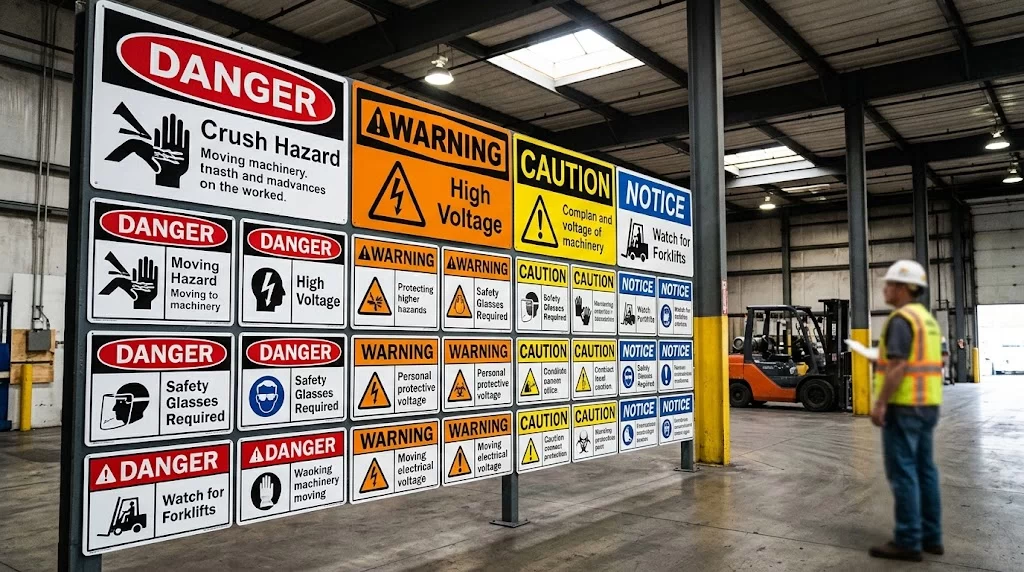
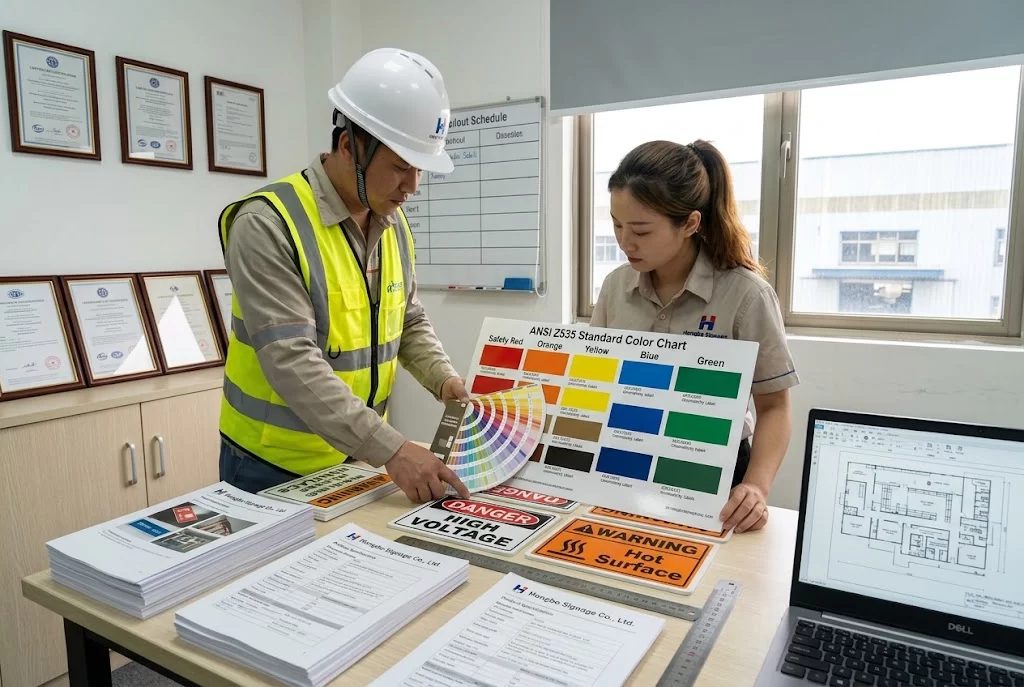
The defining visual feature of ANSI Z535 signs is the signal word panel—a colored horizontal band across the top of the sign carrying the signal word in bold, high-contrast type. The convention is:
- DANGER — red panel, white text. Used for an imminently hazardous situation that, if not avoided, will result in death or serious injury.
- WARNING — orange panel, black text. Used for a potentially hazardous situation that, if not avoided, could result in death or serious injury.
- CAUTION — yellow panel, black text. Used for a potentially hazardous situation that, if not avoided, may result in minor or moderate injury.
- NOTICE — blue or blue-green panel, white or black text. Used for practices related to property damage or general information not tied directly to injury.
Below the signal word panel, most Z535-style signs include a symbol panel (a pictogram, often on a white or yellow field with a diagonal “danger” or “prohibition” slash) and a message panel carrying the text of the hazard, the consequence, and how to avoid it. The structure is deliberately modular so that facilities can standardize a small library of panel combinations and re-use them across sites.
Symbols Versus Text
ANSI Z535.3 encourages pictorial symbols because they survive language barriers and low-attention glances. A well-designed symbol communicates “crush point,” “high voltage,” “slip hazard,” or “eye protection required” without reading a sentence. Best practice is to pair symbols with text—symbol for the fast read, text for the precise instruction.
When designing symbols, use pictograms from the Z535.3 library rather than inventing them. A custom stick figure that looks obvious to the design team may be ambiguous to a forklift operator who learned safety in another country.
How ANSI Z535 Differs From OSHA 1910.145
OSHA 1910.145 is older and narrower. It establishes minimum signal words and colors but does not prescribe the full modular panel layout that Z535 does. In practice, many facilities and their insurers voluntarily adopt Z535 formats because they are more detailed, more internationally recognized, and more readable. Where state or local plans have incorporated ANSI standards by reference, Z535 effectively becomes enforceable.
For a side-by-side comparison of the two regimes, see ANSI Z535 and OSHA sign formats. If you are building an industrial rollout, also read industrial facility safety sign application for placement and material guidance.
Specifying Compliant Signs: Substrate and Finish
An ANSI Z535 sign is only as durable as the material it is printed or fabricated onto. For indoor general areas, rigid PVC or coated aluminum with UV screen printing works well. For exterior, coastal, washdown, or chemical environments, substrate choice becomes critical:
- Powder-coated aluminum resists rust and accepts durable graphics.
- Brushed or mirror stainless steel holds up to salt air and aggressive cleaning.
- Rigid acrylic or polycarbonate combines impact resistance with edge-lighting options.
Hongbo Signage fabricates corrosion-rated exterior safety signs in brushed stainless and powder-coated aluminum, along with industrial identification and warning signs for gate posts, pump yards, and heavy fabrication bays. Where low lighting or shift work makes readability a problem, illuminated hazard-direction signage places the same Z535 vocabulary in backlit housings.
Designing a Z535-Style Sign
When designing or commissioning a Z535-compliant sign, follow this checklist:
- Choose the signal word by severity, not by what looks loudest.
- Use the standard panel color and a contrasting signal word text.
- Add a Z535.3-compliant symbol panel if the hazard has a recognized pictogram.
- Write the message panel in three parts—hazard, consequence, avoidance. For example: “Hot surface. Burn hazard. Allow equipment to cool before servicing.”
- Pick a font and letter height matched to expected viewing distance.
- Add the substrate and mounting appropriate to the environment.
- Document the design standard (ANSI Z535.2-YYYY) on the proof so audits can trace it.
Working With an OEM/ODM Manufacturer
When you send a spec to Hongbo Signage, you might include a CAD or PDF of the sign face, a list of materials, and a mounting note. As an OEM/ODM shop in Guangzhou, we handle laser cutting, bending, welding, powder coating, acrylic fabrication, LED assembly, and aging testing in-house. Typical lead time is 10–25 working days after artwork approval, with export packing built for sea freight. We can also produce bilingual English/Spanish panels or adapt to local language requirements for international clients.
For multi-site operators, centralizing artwork once and re-fabricating as needed reduces drift between facilities. It also makes audit responses faster because one master file applies to every branch.
Cost Considerations
A frequent question is whether ANSI Z535 signs cost more than generic safety signs. Up front, a well-designed modular set can cost slightly more per piece than off-the-shelf vinyl stickers. Over a three-to-five-year horizon, rigid substrates, UV-stable inks, and standardized artwork usually lower total cost of ownership. For a fuller budget view, see cost of compliant ANSI signage.
Auditing an Existing Site
If you are taking over an existing facility, a practical first step is a walk-through audit. Photograph every existing safety sign and ask three questions: Does the signal word match the actual hazard severity? Is the panel color correct for that signal word? Does the substrate survive the local environment? Most legacy sites accumulate a mix of home-grown stickers, faded vinyl, and off-the-shelf signs from different eras. Standardizing onto a small modular kit—same fonts, same panel proportions, same substrate—makes the site instantly more readable and makes future audits faster. Document the current layout before replacement, so you can show the inspector that old signs were deliberately upgraded rather than removed.
What Buyers Should Prepare for a Sign Quote
To commission ANSI Z535-aligned hazard signs accurately, have the following ready:
- Hazard assessment. A walk-through inventory of each hazard point, with the chosen signal word (DANGER, WARNING, CAUTION, NOTICE) and the message text in three parts: hazard, consequence, avoidance.
- Sign panel sizes and viewing distances. Expected legibility distance at each location, so panel proportions, font size, and signal word height are matched.
- Mounting surfaces and environment. Wall, post, machine, forklift, or floor; indoor general area, exterior, coastal, washdown, or chemical exposure, so substrate (aluminum, stainless, powder-coated steel, acrylic) is selected correctly.
- Symbol needs. Whether each hazard has a recognized Z535.3 pictogram, and whether bilingual English/Spanish or other language panels are required.
- Illumination expectations. Whether low-light or shift-work zones need backlit or edge-lit housings.
- Artwork and documentation. Existing logo, color, and brand files, plus any requirement to print the design standard (e.g., ANSI Z535.2) on the proof for audit traceability.
- Quantity across sites. Pieces per location and across branches, so a modular kit can be standardized.
Compliance Note
Signage and egress regulations vary by jurisdiction, building type, sign category, and project scope. The guidance above is for planning purposes and is not legal advice. Before installation, verify current requirements with your local Authority Having Jurisdiction (AHJ), building department, fire marshal, and electrical inspector, and confirm applicable local electrical codes.
Frequently Asked Questions
Q: Is ANSI Z535 legally required?
OSHA 1910.145 is the baseline federal requirement. Many state plans, insurers, customers, and corporate standards reference or require ANSI Z535 formats. Treat it as the safest default and confirm with your AHJ.
Q: Can I mix OSHA 1910.145 and ANSI Z535 signs on the same site?
You can, but it is cleaner to standardize on one visual system across a facility. Mixed formats confuse workers during audits and training.
Q: Are ANSI Z535 signs used outside the United States?
Z535 is widely recognized internationally, especially in North American-owned facilities. For EU projects, the ISO 7010 symbol system is more common; for Australia and New Zealand, AS 1319 conventions apply. Your manufacturer can adapt.
Q: What’s the difference between a sign and a tag under Z535?
A sign is permanent or semi-permanent; a tag (Z535.5) is temporary, used to flag a locked-out machine, a blocked aisle, or a piece of equipment out of service.
Q: Do illuminated safety signs need to follow different color rules?
Signal word colors and panel logic remain the same; illumination affects luminance and legibility, not the meaning of red, orange, or yellow.
Conclusion
ANSI Z535 turns safety communication into a repeatable system: the right signal word, the right color, the right symbol, and the right text, on a substrate that survives the environment. Partnering with an experienced OEM/ODM manufacturer in Guangzhou lets you standardize that system across facilities, control cost, and ship export-ready signs. Always verify the current Z535 edition and confirm your layout with your safety officer and local AHJ.
Designing ANSI Z535-aligned hazard signs for your industrial site?
Hongbo Signage provides OEM/ODM custom signage manufacturing from Guangzhou, China. Get a custom sign quote within 24 hours.